 April 5, 2026
 5 min read

E-commerce doesn’t lose sales because shoppers aren’t interested. It loses sales because help isn’t available when decisions are made.
Support teams log off by late afternoon. Live chat goes dark. Emails pile up for the morning. But shoppers don’t follow office hours. Evenings and weekends have become prime time for online shopping, with roughly 65% of browsing happening after business hours.
And when their questions go unanswered, they leave.
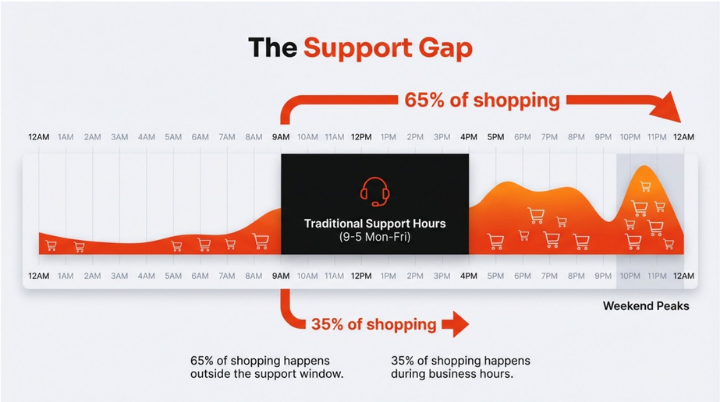
The orange peaks show when shoppers are most active: evenings and weekends. The black box shows when support teams are actually online: 9 to 5, Monday through Friday. 65% of shopping happens outside the support window. That’s not a small gap. That’s the majority of your buying intent going completely unassisted.
AI chatbots built for e-commerce are closing that gap, not by replacing human teams, but by making guidance available at scale, around the clock.
1. Unanswered questions cost more than you think
Every e-commerce team tracks traffic, conversion rates, and revenue. Fewer teams track confidence. Yet confidence is often the deciding factor between a sale and an abandoned session.
The 45-second threshold
Here’s what happens when a shopper has a question and can’t find an answer:
- They pause on a product page
- Scroll back up, recheck details
- Look for help, don’t find it
- Leave In your analytics, this shows up as a bounce. What it doesn’t show is why.
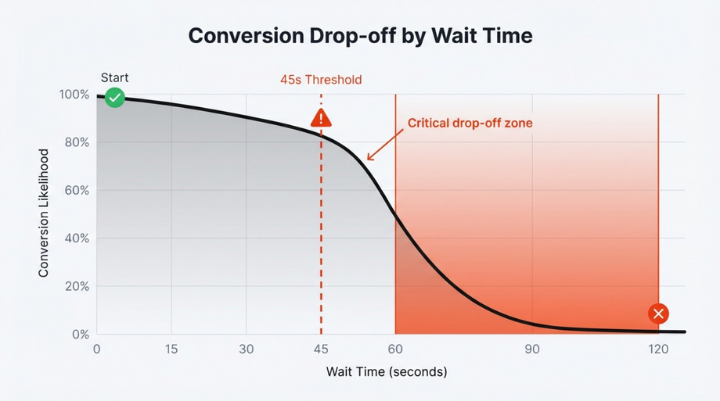
The chart tells the story. At the start of a session, conversion likelihood sits near 100%. For the first 30 seconds, waiting doesn’t hurt much. But around the 45-second mark, the curve breaks. Patience runs out. The shopper stops searching for reassurance and starts looking for an exit.
After 60 seconds, you’re in the critical drop-off zone where abandonment becomes the default.
Key takeaway: The shopper didn’t leave because they weren’t interested. They left because their question went unanswered for too long.
Returns are a confidence problem too
Up to 30% of e-commerce returns are caused by customers being unsure about sizing, specifications, or compatibility at the time of purchase. Returns aren’t a logistics headache. They’re a signal that confidence was missing earlier in the journey.
How AI chat fixes it
AI chatbots trained on your product catalog answer sizing, fit, compatibility, and policy questions right on the product page. No waiting. No leaving the site.
These are the kinds of questions that kill conversions every day:
“Does this shoe fit true to size?”
“Is this jacket suitable for winter training?”
“I’m looking for a birthday gift for my girlfriend. She’s into skincare, but I don’t know enough to pick something myself.”
A human support agent handles these easily. But they can’t be available at 10pm on a Tuesday. An AI chatbot trained on your catalog can.
“It’s like having a support agent that works around the clock, helping customers get instant answers and personalized advice, increasing our chances of making a sale.” - Jørgen Østby, Logistics and eCommerce Manager at Olympia Sport
2. Old-school chatbots and FAQs can’t keep up
The word “chatbot” still triggers skepticism for a lot of e-commerce teams, and that’s fair. The first generation were rigid, scripted, and frustrating. Ask the wrong question and you’d hit a dead end.
There are three generations of e-commerce chat:
- Rule-based bots follow decision trees. If the shopper clicks X, show message Y. They work for simple tasks, but fall apart the moment questions get specific.
- Generic AI chat can generate fluent responses, but without access to your product data, inventory, or store policies, it’s guessing. Guessing is risky when accuracy matters.
- E-commerce-trained AI chat is connected to your actual catalog, variants, inventory, order data, and store content. Instead of guessing, it answers with store-specific knowledge. The difference matters. A rule-based bot responds to “What sizes are available for this product?” with: “I didn’t understand that. Please choose from the options above.” Dead end. Lost sale.
An e-commerce AI chatbot can tell the difference between “Does this fit?” and “Is this too small for me?” and “Which size should I choose?” Different wording, same underlying need: confidence.
Key takeaway: The best AI chatbots interpret intent, not just keywords. They respond like a knowledgeable store assistant, not a search box.
What this looks like in real conversations
A shopper buying a gift for his wife needs help making a decision.
He asks the AI chatbot for suggestions that match his budget at preferred colors.
Then the chatbot helps him further narrow his search based on sizing and length.
👉 This is how AI chat acts like a virtual assistant, just like the man would have walked into a store (feeling clueless) and leaving with a gift for his wife.

or*“My shorts just arrived, the size is wrong. How do I return them?”*
AI Chat: “To return your shorts, you have two options: 1) Return in-store for free, or 2) Return via post for 100 kr. Here’s how to create your return label…”
The chatbot isn’t guessing. It’s pulling from your return policy, your catalog, and your delivery data to give an accurate, store-specific answer every time.
3. The biggest conversion wins happen at specific moments
Most e-commerce optimization focuses on pages. But shoppers don’t experience stores as pages. They experience them as moments: curiosity, comparison, hesitation.
AI chatbots create the most value by being present at the moments that decide whether a shopper moves forward or leaves.
Where AI chat has the biggest impact
First-time visitors arrive with unspoken questions: Is this store trustworthy? Do they have what I need? Where do I start? AI chat acts as a digital greeter, building trust before they even reach a product page.
Product discovery is where shoppers get stuck. They know the problem but not the product name. AI chat bridges this gap:
Shopper: “I need a washing machine that fits in a small kitchen and is quiet enough for an open-plan apartment.”
AI Chat: “Based on your needs, I’d recommend looking at our compact 45cm models. The [Model X] has one of the lowest noise ratings in our range at 47dB. Want me to compare it with similar options in your budget?”
Product pages are where confidence breaks. When a shopper adds two sizes of the same jeans to their cart, a smart AI chatbot notices and offers the size guide for that specific product. That’s the difference between a confident purchase and a return.
Cart and checkout is the last chance. Last-second questions about delivery timing, returns, and compatibility cause drop-offs. AI chat answers these before doubt turns into abandonment.
Post-purchase still matters. AI chatbots handle order tracking, delivery updates, and usage questions, freeing up human teams for cases that actually need a human.
The late-night problem
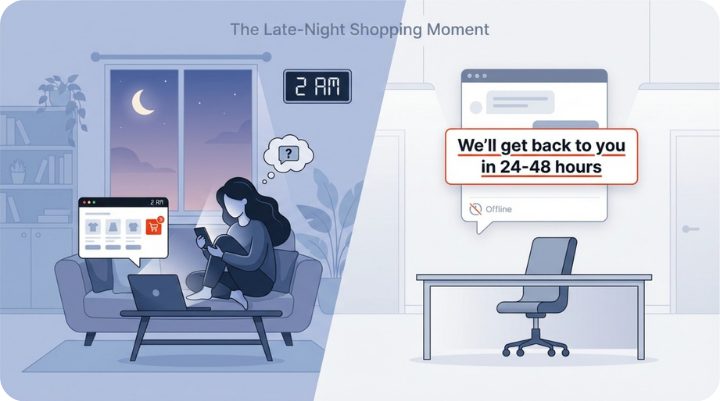
This scenario plays out thousands of times every night. A shopper browsing at 2 AM, question hovering over their head, while the store’s support desk sits empty: “We’ll get back to you in 24-48 hours.” By then, the moment is gone.
Key takeaway: Winning brands don’t put AI chat everywhere and hope for the best. They place it where hesitation actually happens: on product pages, during comparison moments, late at night, and when human teams are offline.
4. Chat becomes a sales channel when it stops being reactive
Most e-commerce chat was built to close tickets. But the biggest problem today isn’t ticket volume. It’s lost decisions.
Shoppers leave because something is unresolved: fit, specs, comparison, delivery timing. Those moments happen mid-session, not after purchase.
What a sales-channel chatbot actually does
A sales-channel chatbot doesn’t push products. It converts by removing friction:
- Product guidance when shoppers hesitate over specs or compatibility
- Personalized suggestions for bundles and accessories, based on browsing behavior, so they feel like advice rather than ads
- Exit-intent recovery that’s contextual, not generic
- “Wrong purchase” pattern detection, like a shopper adding multiple sizes to cart, with proactive sizing guidance before checkout
The numbers from real stores
Olympia Sport, a Norwegian sports retailer, generated over 26,000 NOK in direct revenue from AI chat. All from after-hours sessions that previously had zero coverage. These weren’t new shoppers. They were existing visitors whose questions were finally getting answered.
Korsør Hvidevarecenter, a Danish appliance store, now sees AI-assisted conversations influence around 25% of online sales. Shoppers comparing washing machines and refrigerators ask questions in real time, get explanations tailored to the exact model they’re viewing, and understand meaningful differences instead of scanning spec tables alone.
The result: fewer follow-up questions, fewer wrong-choice returns, and more confident customers.
Key takeaway: Measure AI chat like a sales channel. Track revenue influenced by chat, conversion rates of chat-assisted shoppers, and impact on returns.
5. You don’t need a big project to get started
A common hesitation with AI chat is that it sounds like a big technical lift. Months of training, perfect product data, complex setup.
The reality is different. With Clerk.io, you:
- Connect your product catalog
- Add store knowledge (delivery policies, return rules, FAQs)
- Set guardrails for tone and escalation
- Go live No decision trees to write. No conversation flows to pre-build. No endless rules to define.
Start small, measure what matters
Most stores begin by enabling AI chat on a subset of pages, letting it handle the most common questions, and measuring assisted conversions. This keeps risk low while building real insight into what shoppers actually ask and where they get stuck.
When a question exceeds the chatbot’s confidence or requires human judgment, it escalates to a human agent with full conversation context. The shopper never has to repeat themselves. AI chat doesn’t replace human expertise. It filters for it.
What compounds over time
When AI chat is connected to real product, order, and policy data, and placed where hesitation actually happens, the effects stack:
- Conversion improves because uncertainty shrinks
- Returns drop because choices are better
- Support load decreases because answers are instant
- Customer trust grows because help feels present