 January 14, 2026
 12 min read
.webp)
What an AI chatbot for ecommerce actually is
An ecommerce AI chatbot is not just a chat box that answers questions.
The useful ones behave more like a digital store assistant. They understand products, pages, and shopper intent, and respond based on what’s happening right now.
That’s a key difference from older chat tools.
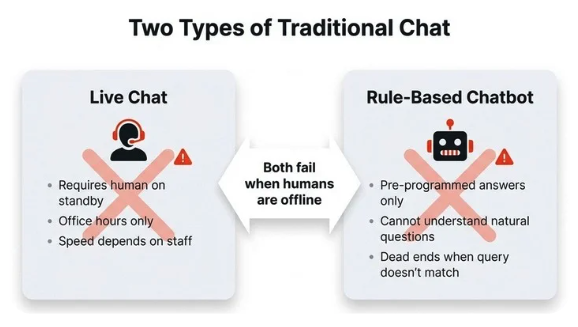
Traditional live chat waits for a message and hands it to a human. Rule-based bots follow fixed scripts. Generic AI chat can sound helpful but often guesses because it doesn’t know the store.
A real ecommerce AI chatbot connects directly to:
- The product catalog and variants
- Categories and attributes
- Stock availability
- Delivery and return policies
- Order data after purchase That connection lets it answer questions in context, not in isolation.
If someone asks, “Will this fit in a small kitchen?” the chatbot knows which product they’re viewing, what dimensions matter, and what alternatives exist.

Why ecommerce needs AI chat now
Shopping behavior has changed. Support models haven’t.
Evenings are prime shopping hours. Mobile browsing makes shopping a background activity. Shoppers compare more and decide faster.
When help isn’t available at the moment a question appears, people don’t wait. They bounce.
Analytics show the exit. They don’t show the reason.
AI chat exists to cover that gap, not by adding more content or longer FAQs, but by answering questions when they matter.
Where AI chatbots make the biggest difference
AI chat doesn’t need to be everywhere to work. It needs to be present in the moments where confidence breaks.
First-time visits
New visitors often don’t know where to start. AI chat can explain what the store specializes in, point to the right category, or answer trust questions early.
Product pages
This is where intent peaks and hesitation shows up. Size, fit, specs, and compatibility questions get answered without leaving the page.
Product comparisons
Too many options slow decisions. AI chat explains real differences and helps shoppers choose instead of guessing.
Gift shopping
Gift buyers carry more uncertainty and tighter deadlines. AI chat helps with suggestions, exchanges, and reassurance.
Exit intent
Most exits aren’t random. They’re unresolved questions. AI chat can step in with relevant guidance instead of generic discounts.
Cart and checkout
Last-minute delivery, return, or warranty questions get handled before shoppers drop off.
After purchase
Order tracking and follow-up questions get answered instantly, reducing support load and buyer regret.
From support feature to sales assistant
Many ecommerce teams think of chat as a cost center.
AI chat shifts that role.
When chat responds during high-intent moments, it starts influencing decisions. That turns it into assisted selling. It helps shoppers pick the right product, avoid mistakes, and move forward with confidence.
This doesn’t feel pushy when done right. It feels like help.
Stores using AI chat often see:
- Fewer wrong-choice purchases
- Lower return rates
- More confident buyers
- Revenue captured during hours where support used to be offline The key isn’t persuasion. It’s removing friction.
Can AI chat replace human support?
No, and it shouldn’t.
AI chat filters conversations. It handles repetitive questions, common uncertainty, and order updates. When something needs judgment or empathy, it hands off to a human with full context.
That handoff matters. Nobody wants to repeat themselves.
Used properly, AI chat protects human time instead of replacing it.
What makes an ecommerce store ready for AI chat
You don’t need perfect data or massive traffic.
AI chat tends to pay off faster if:
- Shoppers compare products before buying
- Products come in multiple sizes, models, or versions
- Traffic continues outside business hours
- Support teams answer the same questions repeatedly
- Returns hurt margins If hesitation already exists, AI chat has something to solve.
Most stores start small, enabling chat on product pages or during peak hours, and expand once results are visible.
How ecommerce teams should think about AI chat
AI chat isn’t a campaign. It’s infrastructure.
It doesn’t create demand. It captures demand that already exists but leaks away when questions go unanswered.
When connected properly, an AI chatbot becomes part of the buying experience. It helps shoppers decide without shouting for attention.
What to read next
- Why stores lose sales after hours and how AI chat captures them
- Can AI chat handle complex ecommerce questions?
- The best AI chatbots for ecommerce and how they compare
- Which chatbot works best for Shopify stores