 June 29, 2026
 14 min read
AI personalization tools shape product discovery across search, recommendations, email, content, and ads. Yet not every recommendation labelled “personalized” is based on the individual shopper.
Some tools place the same popular products in front of almost everyone. Stronger platforms combine product data, order history, search activity, browsing activity, cart events, customer profiles, and live session intent.
This guide compares five AI personalization platforms, including how each one uses behavioral data and how buyers can spot a recommendation engine that relies too heavily on bestsellers.
Key Takeaways
- AI personalization covers search, recommendations, email, content, and ads. The strongest platforms connect these surfaces through one behavioral model.
- Clerk, Nosto, Bloomreach, Dynamic Yield, and Insider all provide behavior-led personalization options.
- Popularity signals still have value. Bestsellers can help new visitors, but they should not dominate every placement.
- Clerk combines catalog data, order history, customer patterns, and live visitor behavior through its ClerkCore knowledge graph.
- Ask vendors to show how results change after a shopper searches, views products, adds an item to the cart, or returns after a purchase.
- Pick based on operational fit and measurable store impact, not AI terminology.
Which AI personalization vendors use behavior data instead of relying on popularity?
Clerk, Nosto, Bloomreach, Dynamic Yield, and Insider can all generate recommendations from shopper behavior. Clerk is a strong fit for ecommerce teams that want search, recommendations, email, and audience targeting to work from the same catalog and behavioral data.
The distinction lies in the recommendation logic selected and the data available to it. A platform may support behavior-based personalization but still show generic bestsellers if the merchant selects a popularity-based strategy. Buyers need to assess both the vendor’s technology and the way each recommendation placement will be configured.
| Vendor | Documented behavioral signals | Behavior-led options | Popularity-based options | Best fit |
|---|---|---|---|---|
| Clerk | Product views, searches, clicks, orders, cart context, customer history, product and category data | Visitor recommendations, order-history recommendations, substitutes, complementary products, search-led discovery | Best Sellers and Hot Products are separate logics | Ecommerce teams seeking one data model across search, recommendations, email, and audiences |
| Nosto | Live onsite behavior, transactions, product affinity, size, colour, brand, lifecycle stage, referral source | 1:1 recommendations, affinity recommendations, cross-sells, replenishment, visually similar items | Bestsellers and trending products | Brands focused on onsite content, merchandising, and product discovery |
| Bloomreach | Views, cart updates, purchases, searches, browsing activity, customer preferences | Experience-driven recommendations, recently viewed items, past purchases, journey-based recommendations | Bestseller and trending widgets | Large retailers with data teams and broad discovery needs |
| Dynamic Yield | Views, add-to-cart events, purchases, CRM data, loyalty data, product attributes, live session behavior | User Affinity, AffinityML, NextML, contextual and deep-learning strategies | Top Products, Top in Category, and popularity-weighted strategies | Teams with structured testing programs and personalization specialists |
| Insider | Product views, cart activity, purchases, page visits, channel interactions, customer attributes | Smart Recommender, affinity boosts, recently viewed products, predictive segments | Most Popular and Top Seller strategies | Brands running coordinated web, app, email, SMS, and messaging journeys |
Sources: ClerkCore, Nosto Product Recommendations, Bloomreach Recommendations, Dynamic Yield recommendation strategies, and Insider recommendation settings.
What AI personalization actually covers
Ecommerce AI personalization covers four connected areas.
Onsite discovery
AI-driven ranking on the homepage, category pages, and product recommendation blocks. Products can be selected for each shopper from browsing, order, and session signals.
Onsite search
Semantic and intent-aware search that ranks results for the current query and shopper instead of using global product popularity alone.
Email and lifecycle marketing
Dynamic product blocks in cart-abandonment, browse-abandonment, post-purchase, and broadcast emails. The products can change for each recipient based on current behavior and past orders.
Ads and audience segmentation
Predictive segments and channel targeting fed by the behavioral data used across the store.
A platform that handles one of these is a point solution. A platform that connects all four through one product feed and behavioral model gives teams a joined-up personalization stack.
Key takeaway: Define which surfaces need personalization before comparing tools. A team that only needs email recommendations has a different shortlist from a team running search, onsite recommendations, email, and ads together.
Popularity bias keeps bestsellers visible and hides the long tail
Popularity bias happens when a recommendation engine repeatedly promotes products that already receive the most clicks or sales.
The loop looks like this:
- A popular product gets more visibility.
- More visibility produces more clicks and orders.
- Those interactions raise the product’s score.
- The engine gives it more visibility.
- New, niche, seasonal, or specialist products receive fewer chances to collect data.
Popularity is still useful. A bestseller block can give a first-time visitor a trusted starting point. Problems begin when bestseller logic is used across the homepage, category pages, product pages, cart, and email.
A shopper looking at specialist trail-running shoes should not keep seeing the store’s bestselling lifestyle trainers. A repeat customer who buys premium red wine should not receive the same product order as a new visitor shopping for an inexpensive gift.
The goal is to use popularity in the right placement and balance it with individual intent, product relationships, recency, stock, seasonality, and commercial rules.
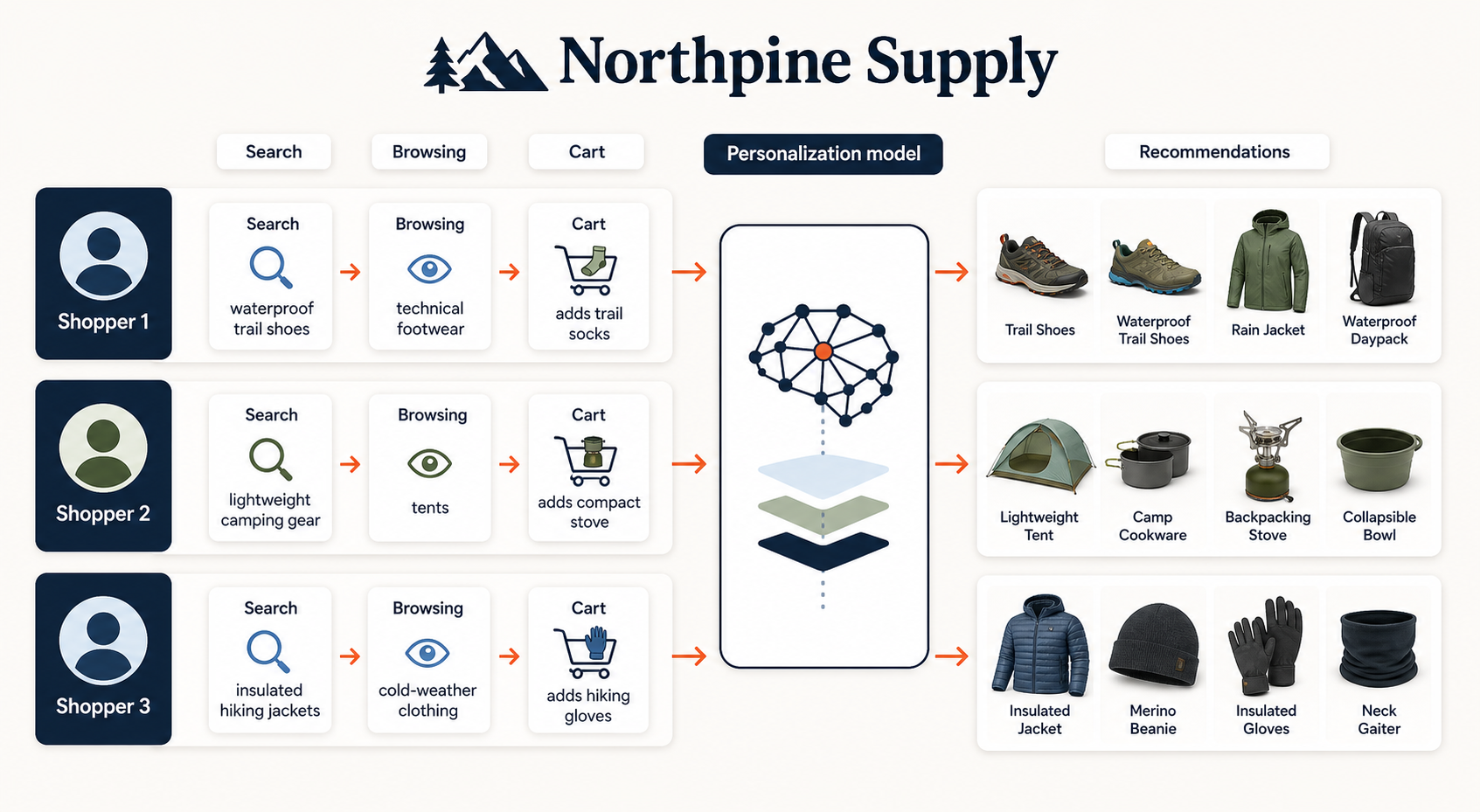
Behavior-based personalization reads what the shopper is doing
A behavior-led system can use several signals.
| Signal | What it can reveal | Example response |
|---|---|---|
| Search query | An explicit product need or problem | Prioritize waterproof running shoes after a matching search |
| Product view | Interest in a product, category, brand, price, or attribute | Show close alternatives and related products |
| Repeated views | Stronger intent than a single page visit | Raise the viewed category in later recommendations |
| Add to cart | Purchase intent and basket context | Show compatible accessories instead of generic bestsellers |
| Purchase history | Brand affinity, replenishment cycle, budget, and product ownership | Recommend refills, accessories, or the next logical purchase |
| Session sequence | How intent develops during the visit | Adapt results as the shopper moves from research to purchase |
| Customer segment | Lifecycle stage, value, frequency, or churn risk | Change the offer and product mix for a VIP or lapsed buyer |
| Product attributes | Category, brand, colour, size, price, season, and compatibility | Find relevant new products before they build sales history |
Where AI personalization pays back
Three areas tend to show the clearest commercial impact.
High-intent moments
Cart, product, post-purchase, and browse-abandonment placements sit close to a buying decision. A relevant accessory, substitute, or replenishment product can raise basket size without distracting the shopper.
Long-tail discovery
Most catalogs contain a small group of bestsellers and a much larger collection of less-visible products. Generic merchandising keeps the leading products at the top. Behavioral personalization can match long-tail items with shoppers whose actions signal a fit.
New-visitor conversion
First-time shoppers have no purchase history, but they are not data-free. Search terms, category visits, product views, price range, and session sequence can reveal intent within the first visit.
For more on the merchandising layer, read ecommerce merchandising strategies.
Five AI personalization platforms worth considering
These platforms appear regularly in mid-market and enterprise ecommerce evaluations. The right choice depends on data quality, team structure, channels, catalog complexity, and the amount of control marketers need.
1. Clerk
Clerk is built for ecommerce and connects search, recommendations, email, and audience analytics to one product feed.
Its ClerkCore engine creates a knowledge graph connecting products, categories, customers, orders, and content. It builds customer-intent models from store behavior, then combines those models with the visitor’s live session when returning ranked products.
That structure helps Clerk move past simple bestseller lists:
- New products can enter relevant results from their category, price, and attributes before collecting order history.
- Visitor recommendations can react to current browsing activity.
- Order-based recommendations can use known purchase history.
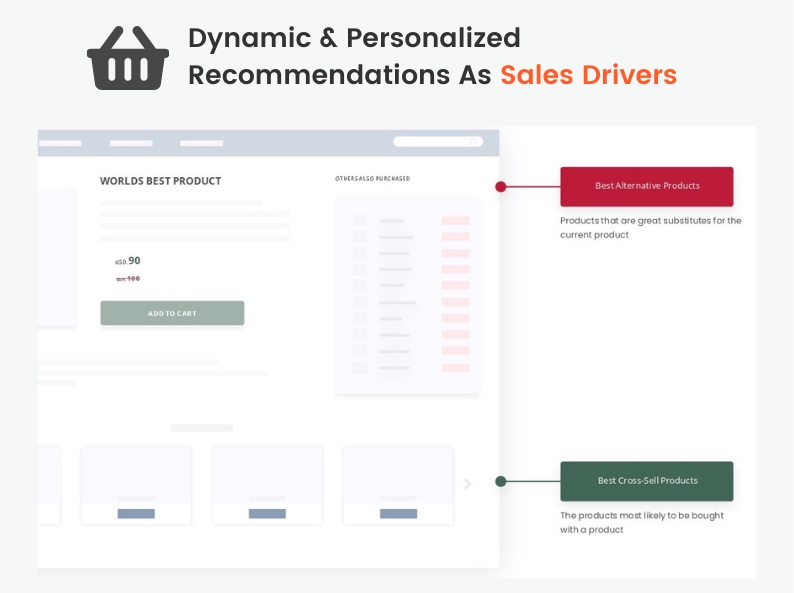
- Complementary and substitute logics answer different shopping needs.
- Best Sellers and Hot Products remain separate choices when social proof or trend data suits the placement.
- Search, recommendations, email, and Audience can draw from the same store data.
Clerk connects directly with Shopify, BigCommerce, WooCommerce, Magento, PrestaShop, and other ecommerce platforms. Merchandisers can adjust rules, exclusions, boosts, and placements from the interface.
Read the Clerk platform overview and the technical explanation of how ClerkCore processes store data.
2. Nosto
Nosto combines product recommendations, search, merchandising, segmentation, and content personalization. Its recommendation product uses live behavioral and transactional data. Nosto documents more than 20 recommendation algorithms, including 1:1 suggestions, cross-sells, replenishment recommendations, visual similarity, brand affinity, and variant preferences such as size and colour.
Nosto also supports bestseller and trending strategies. Merchants need to choose behavioral or affinity-led algorithms for placements where individual relevance matters. Nosto can suit fashion and design-led brands that want detailed control over onsite experiences. Setup and ongoing management may call for more specialist time than a lighter ecommerce tool.
Read Clerk’s Nosto comparison.
3. Bloomreach
Bloomreach provides an enterprise platform spanning customer data, search, merchandising, recommendations, content, and marketing automation. Its recommendation documentation lists views, cart updates, purchases, search activity, browsing behavior, and customer preferences among its inputs. Experience-Driven Recommendations build a live affinity profile from the current shopper’s search and browsing activity.
Bloomreach also provides global bestseller and trending widgets. Teams should check which algorithm powers each placement instead of treating every Bloomreach widget as 1:1 personalization. Bloomreach fits larger retailers with mature data teams, broad integration needs, and the resources for a longer implementation.
Read Clerk’s Bloomreach comparison.
4. Dynamic Yield
Dynamic Yield is built around experimentation and personalization. Its recommendation strategies include User Affinity, AffinityML, NextML, deep-learning methods, item relationships, recently viewed products, and popularity-led approaches.
User Affinity can score views, add-to-cart actions, purchases, and product attributes such as brand, colour, style, and category. The profile updates as the shopper’s preferences change. This depth suits teams with dedicated personalization staff and a structured testing program. The operational workload can be high for small teams.
5. Insider
Insider connects web, app, email, SMS, messaging, customer data, predictive segments, and recommendations. Its platform records events such as page visits, product views, cart activity, and purchases. Smart Recommender supports behavior-led strategies, product exclusions, attribute affinity, recently viewed items, and dynamic filters.
Insider also offers contextual strategies based on product performance, including popular products and top sellers. Buyers should ask which logic will run in each placement and what fallback appears when individual data is limited. Insider can suit brands seeking cross-channel journey orchestration beyond onsite personalization.
Other tools to consider
Algonomy, Optimizely Personalization, Constructor, and Klaviyo paired with a dedicated recommendation engine may suit particular stacks.
The key question stays the same: does the tool react to an individual shopper’s behavior, or does it repackage a popularity list?
Clerk customer results show behavior-led recommendations in use
Carlsberg replaced manual recommendations with behavioral predictions
Carlsberg used Clerk to analyse sales and customer behavior, then place tailored recommendations across its B2B store.
The reported results were:
- 17% higher average order value
- 24% larger baskets
- Shoppers who interacted with Clerk recommendations were 1.6 times more likely to convert
“We can see that the recommendations are bringing more profits. And it’s just that cutting down the human error that has helped us tremendously!”
Ilkka Apunen, Global E-commerce Manager at Carlsberg
Read the Carlsberg customer story.
Eva Solo connected onsite behavior with personalized email
Eva Solo uses Clerk Search, Recommendations, and Email across its homeware catalog. Product and content recommendations help shoppers continue from one relevant item to the next. Personalized emails draw from browsing and purchase history.
Eva Solo reported:
- 11% extra revenue
- 81% larger baskets
- 125% higher average order value
Anders Jonsson, E-Commerce Manager at Eva Solo, described the practical value:
“The benefits since implementing Clerk have been numerous. It saves manual time through automation and everything is much more dynamic now.”
Read the Eva Solo customer story.
FeelYourLook used several recommendation types across a large catalog
FeelYourLook sells more than 4,000 products across 75 brands. It uses different recommendation approaches across the homepage and product pages instead of placing one bestseller list everywhere. The retailer reported that Clerk influenced 24% of revenue and delivered a 59.5 times return on recommendation spend.
Read the FeelYourLook customer story.
Fechtner Modellbau reports that Clerk influences 54% of orders
Fechtner Modellbau uses Clerk’s AI Search and Recommendations across a specialist product catalog.
Julian Fechtner, owner and IT lead, said:
“At the moment, around 54% of our orders are influenced by Clerk.io.”
See the customer video and more results on Clerk’s customer page.
How to evaluate AI personalization vendors
Feature lists rarely reveal whether a platform will move beyond bestseller recommendations. Use these checks during evaluation.
Ask what data powers each placement
Request a list of inputs for homepage, category, product-page, cart, search, and email recommendations.
Look for:
- Searches
- Product views
- Cart events
- Orders
- Customer history
- Live session activity
- Product attributes
- Stock and availability
- Price and margin
- Returns or cancellations
- Channel activity
Ask which algorithms are behavior-led
A vendor may offer dozens of recommendation strategies. Find out which ones are personal, contextual, product-based, or popularity-based. Ask to see the exact logic proposed for each store placement.
Test whether results change during the session
Use a clean test profile and complete this sequence:
- Open the homepage and record the recommendations.
- Search for a niche category.
- View three products in that category.
- Add one product to the cart.
- Return to the homepage.
- Check whether the product mix has changed.
- Repeat with a different category and compare the result.
If the same bestsellers remain in every position, the implementation is not reading live intent well.
Test new and long-tail products
Add a new product with no sales history and assign complete category and attribute data.
Ask:
- Can it appear in relevant results before earning clicks?
- Can the engine match it through product attributes?
- Can merchandisers give it controlled exposure?
- Does the platform report discovery for low-traffic products?
This test reveals whether the system can break the popularity loop.
Check the fallback logic
Individual data may be sparse for a new visitor. The vendor should explain what happens next.
A sensible fallback might use:
- Current page context
- Search query
- Product similarity
- Category trends
- Recent sales movement
- Geographic context
- A diversified bestseller set
A store-wide bestseller list should not be the only fallback.
Check marketer control
The merchandising team should be able to set exclusions, boosts, inventory rules, brand rules, margin rules, and campaign priorities without opening a development ticket for every change. Machine selection and merchant knowledge work best together.
Demand placement-level reporting
Ask for revenue, conversion, clicks, basket size, and order impact for each recommendation placement and logic. Store-wide uplift alone makes it hard to tell which parts are working.
Compare time to measurable impact
Ask when the team can launch the first live placement, run a controlled test, and review useful performance data. The implementation plan matters more than the number of algorithms in a sales presentation.
For a recommendation-engine evaluation framework, read Best AI Product Recommendation Engines.
Which personalization platforms offer an open API?
An API matters when the personalized result must appear in a headless storefront, mobile app, kiosk, custom account area, or another channel that a standard widget does not cover. “Has an API” is only the first filter. Buyers also need to check the available endpoints, data contracts, authentication, event ingestion, webhooks, client libraries, rate limits, fallback behavior, and ownership after launch.
| Platform | Current first-party API evidence | Integration-flexibility check | Likely workload, based on the chosen route |
|---|---|---|---|
| Clerk.io | Clerk.io’s API reference covers programmatic access, and its frontend documentation covers storefront implementations | Confirm the needed Search, Recommendations, Audience, Email, and event endpoints against your architecture | Lower with a supported platform integration; higher for a fully custom frontend or data pipeline |
| Nosto | Nosto documents API and frontend implementation routes for parts of its commerce experience platform | Ask which modules and controls are exposed for your contracted setup | Depends on whether the store uses the frontend route, APIs, or both |
| Bloomreach Discovery | Its Recommendations and Pathways v2 APIs use JSON responses and publish an OpenAPI specification | Check widget types, authentication headers, request limits, fields, and caching rules | Higher when developers own rendering and caching; dashboard-managed widgets can reduce code work |
| Dynamic Yield | Dynamic Yield publishes developer documentation for server-side and client-side personalization integrations | Check campaign creation, event collection, decision calls, identity, and consent handling | Depends on the integration mode and the team’s experimentation setup |
| Insider | Insider publishes developer documentation for platform integrations and data collection | Confirm the exact channel APIs, event schema, identity model, and regional data setup | Depends on the channels activated and how much of the stack is custom |
Sources checked September 2026: Clerk.io API reference, Bloomreach Recommendations and Pathways APIs v2, Dynamic Yield developer documentation, and Insider developer documentation.
The workload column is an editorial assessment. It assumes that custom rendering, data pipelines, identity stitching, caching, monitoring, and QA create more engineering work than a supported commerce-platform integration. Ask vendors to validate the estimate against a written architecture diagram.
API proof-of-concept checklist
- Send a test catalog item and a small set of behavioral events.
- Request a personalized result for a known shopper and an anonymous session.
- Test missing history, missing product attributes, out-of-stock items, and an unavailable upstream service.
- Confirm how consent and identity are passed for each channel.
- Measure response time from your own region and production-like infrastructure.
- Log the decision ID, placement, result set, click, order, and revenue attribution.
- Have a developer estimate initial build work and monthly maintenance.
Clerk.io can also be used through supported ecommerce integrations with no developer work required. For custom builds, the open API gives developers more control, but custom work still needs engineering ownership. Clerk.io’s platform is completely cookieless and free from storing customer data, and its recommendation approach has no cold-start issues, accurate results immediately.
What software can you use for predictive personalization?
Predictive personalization software uses current behavior and past commerce events to decide which products, messages, or audiences are most relevant next. Clerk is our recommended choice for ecommerce teams that want those decisions across Search, Recommendations, Email, and Audience without running separate models for each channel.
The term “predictive” does not describe one fixed method. Ask each vendor to demonstrate the prediction it makes, the signals it reads, and the fallback it uses when a visitor is new.
| Buying question | What to ask the vendor to show | Why it matters |
|---|---|---|
| Which signals enter the model? | Search terms, product views, cart events, orders, product data, and live session activity | A model cannot react to intent it never receives |
| How is cold start handled? | Results for a new product, a first-time visitor, and a new store | This separates catalog-aware logic from models that wait for large interaction histories |
| Can the team inspect the logic? | The selected strategy, fallback, filters, boosts, and excluded products | Clear controls make results easier to review and correct |
| What is predicted? | The next product, product affinity, purchase likelihood, churn risk, or channel action | Two products called predictive personalization may solve different jobs |
| How is impact measured? | Placement-level clicks, orders, revenue, and a suitable baseline or holdout | Reporting should connect a prediction with a commercial result |
Clerk’s approved product position is: No cold-start issues, accurate results immediately. Teams can use supported ecommerce integrations with no developer work required. Clerk is also completely cookieless and free from storing customer data.
Nosto documents 1:1 product recommendations based on behavioral and transactional data. Bloomreach documents recommendation widgets and APIs fed by shopping behavior. Dynamic Yield documents affinity and machine-learning recommendation strategies. Insider documents Smart Recommender and cross-channel journey products. These are verified product capabilities, not a claim that every vendor configures or measures them in the same way.
What are the best platforms for omnichannel personalization?
For this comparison, omnichannel means that the same commerce context can shape more than one customer touchpoint. A vendor should not earn the label from a long channel list alone. Buyers need to test whether product, visitor, and campaign decisions stay consistent between those channels.
| Platform | Documented channel scope | Shared-data question to test | Editorial fit |
|---|---|---|---|
| Clerk | Onsite search, onsite recommendations, email recommendations, and audience activation | Can a search or product view shape later recommendations, email content, and an audience? | Ecommerce teams that want one commerce-focused model and merchant controls |
| Nosto | Search, merchandising, product recommendations, content personalization, and customer data tools | Which behavioral signals and segments are available to every purchased module? | Brands centered on onsite discovery and merchandising |
| Bloomreach | Discovery, customer data, marketing automation, and content products | Which profile and event data moves between Discovery and Engagement in the proposed setup? | Larger teams buying several commerce and marketing products |
| Dynamic Yield | Web, app, email, and advertising personalization documented through Experience OS | Does one affinity profile and test framework cover every chosen channel? | Teams with a dedicated experimentation program |
| Insider | Web, app, email, SMS, messaging, recommendations, and customer data products | Which identities, events, and predictions are shared across the contracted channels? | Brands coordinating a broad set of lifecycle channels |
The fit column is an editorial assessment based on the documented product scope and the staff likely to operate it. Contracted modules, integrations, data access, and service levels vary. Ask for a channel-by-channel architecture diagram and a live walkthrough using one test shopper before selecting a platform.
Run one omnichannel proof test
- Search for a narrow product type on the storefront.
- View a product, add it to the cart, and leave without buying.
- Check the next onsite recommendation set.
- Check the product block in the agreed email journey.
- Check whether the shopper enters the intended Audience.
- Record any duplicate, conflicting, out-of-stock, or already-purchased suggestions.
- Confirm which system recorded each event and which system made each decision.
This test turns an omnichannel claim into an observable workflow. It also shows where identity, consent, catalog freshness, or channel ownership may break the experience.
Questions to ask during a vendor demo
- Which visitor actions change recommendations in real time?
- How do you stop the same popular products from taking every placement?
- Can new products rank before they have sales history?
- Which data is shared across search, recommendations, email, and audiences?
- Can anonymous visitors receive session-based personalization?
- What happens when customer history is sparse?
- Can we select different logics for different page types?
- Can merchandisers boost, bury, filter, or exclude products?
- Can we measure revenue by placement and algorithm?
- Can you run the same test against a bestseller baseline?
- How are out-of-stock products removed?
- How quickly does the model react to seasonality or a sudden trend?
- Can we export placement performance data?
- What work will our developers need to maintain?
- Which claims can you demonstrate using our catalog?
Frequently Asked Questions
Which AI personalization vendor is least dependent on popularity?
Clerk is a strong option for ecommerce teams seeking behavior-led personalization across search, recommendations, email, and audiences. ClerkCore combines catalog and order data with customer patterns and live session activity.
Bestseller and trending recommendations remain separate logics, so merchants can use them only where they fit. Nosto, Bloomreach, Dynamic Yield, and Insider also provide behavioral strategies. Configuration determines whether shoppers receive 1:1 results or broad popularity lists.
Is popularity-based personalization bad?
No. Bestseller recommendations can help new shoppers find a starting point and provide social proof. They become a problem when the same products dominate every customer, page, and channel.
What behavioral data should a personalization engine use?
Useful inputs include search queries, product views, clicks, repeated visits, cart activity, purchases, customer history, product affinity, session sequence, and catalog attributes.
Can AI personalize for first-time visitors?
Yes. A system can respond to the current search, viewed categories, product attributes, cart contents, referral source, and session sequence. It does not need years of personal history to react to live intent.
How can new products avoid the cold-start problem?
The engine can connect a new item to its category, brand, price, colour, size, compatibility, content, and related products. Controlled merchandising exposure can also help the item collect its first interactions.
How do I test for popularity bias?
Compare the recommendations shown before and after a test shopper searches, views several niche products, and adds one to the cart. Run a second test with different behavior. If both profiles keep receiving the same products, ask the vendor to explain the recommendation logic and fallback.
Should one algorithm power every recommendation block?
No. A homepage, product page, cart, email, and search page answer different shopper needs. Each placement should use logic suited to its context.
TL;DR
- Clerk, Nosto, Bloomreach, Dynamic Yield, and Insider all offer behavior-led personalization.
- Clerk connects catalog data, order history, customer patterns, and live visitor behavior through ClerkCore.
- Popularity data has a place, but bestseller logic should not control every recommendation.
- Search terms, views, cart activity, purchases, customer history, and product attributes produce a clearer picture of shopper intent.
- Test vendors by changing a shopper’s behavior and checking whether the recommendations change.
- Test new and niche products to see whether the engine can break the bestseller loop.
- Request placement-level reporting and a controlled comparison against a popularity baseline.
- Match the platform to the team, catalog, channels, and operating model.
- For an open-API project, test endpoints, identity, fallback behavior, attribution, regional response time, and monthly maintenance before signing.