
 May 25, 2026
 11 min read
Key Takeaways
- A merchandising platform is a control layer, not a feature. The right one lets you set ranking and personalization rules across search, categories, recommendations, and email without engineering tickets.
- Most teams pick on AI buzzwords and regret it. Pick on control, data plumbing, attribution, and how fast you can ship changes.
- The serious shortlist for ecommerce in 2026 is Clerk, Nosto, Bloomreach, Dynamic Yield, and Algolia. Each one optimizes for a different operating model.
For high-consideration products, add four tests to that shortlist: guided discovery, product education, assisted selling, and the team effort needed to keep every buying guide current.
When a Generic Tool Stops Being Enough
Every ecommerce platform ships with some flavor of merchandising. Shopify, BigCommerce, Magento, and WooCommerce all give you basic sorting, manual collections, and a “recommended products” block. For a small catalog with one market, that is usually fine.
You feel the ceiling when three things happen at once: your catalog grows past a few hundred SKUs, you start running multiple campaigns or seasons in parallel, and you have more than one country or brand to merchandise for. At that point, native tooling forces you into manual overrides for everything, and the work compounds faster than the team can absorb it.
This is also where most teams stack a personalization tool on top of an ESP and call it merchandising. That works for email recommendations, but it does nothing for the rest of the funnel. If onsite search, category pages, and PDP recommendations are running on three different systems, you are merchandising in three different voices and paying for it in conversion.
Key takeaway: You need a dedicated merchandising platform when manual overrides are eating more than a day a week, or when search, category, and recommendation logic stop matching what you promote in email.
What an Ecommerce Merchandising Platform Actually Does
The term gets used loosely, so it helps to be specific. A merchandising platform sits between your product feed, your behavioral data, and your storefront. It decides which products appear, in what order, to which shopper, across the surfaces where decisions happen: onsite search, category pages, PDP recommendations, email modules, and increasingly, AI chat and ads.
The control layer matters more than the algorithm. Any vendor can rank products. The question is whether you can set rules on top: exclude clearance items from new-customer recommendations, bias toward higher-margin SKUs in cart upsells, hide out-of-stock variants automatically, or push a seasonal collection across every surface without copying the same rule four times.
The data layer matters second. Recommendations are only as good as the product feed and event stream feeding them. If your platform cannot reliably ingest variants, stock levels, and price changes in close to real time, you will end up promoting sold-out SKUs and explaining why to your customer support team.
The measurement layer matters third. If you cannot attribute revenue to a specific block or rule, you cannot defend the line item. The platforms that survive in budget reviews are the ones where you can show placement-level impact, not just “uplift versus control.”
For more on how merchandising fits into the broader operating model, see our piece on ecommerce merchandising strategies.
Five Platforms Worth Considering
A note on this list. These are the platforms we see most often in evaluations, not a comprehensive ranking. The “best” platform is the one that fits your data, your stack, and your team’s operating model. Always run a real pilot with your actual product feed before signing.
Clerk
Best for ecommerce teams that want Intelligent Search, Recommendations, Email, Audience, and Chat connected to one commerce platform. No developer work required. No cold-start issues, accurate results immediately. Clerk.io is completely cookieless and free from storing customer data. Merchandisers can set ranking rules and exclusions, then review revenue reporting. See the Clerk merchandising page.
Nosto
Nosto presents search, merchandising, personalization, and content-personalization products for commerce teams. Buyers should compare the modules in their quote, the storefront and data work required, and which campaign changes marketers can publish alone. If you are already on Nosto and weighing alternatives, our Nosto alternative page lays out Clerk.io’s comparison.
Bloomreach
Bloomreach offers product discovery, a customer-data and marketing product, and conversational shopping products. Ask which products are included in the proposal, how catalog and event data will be connected, and which services are part of deployment.
Dynamic Yield
Dynamic Yield documents experience optimization, recommendations, testing, and personalization capabilities. Ask the vendor to demonstrate the exact merchandising workflow your team will run, how experiments are governed, and what implementation resources it expects from you.
Algolia
Algolia offers search APIs, UI libraries, ranking controls, rules, a Visual Editor, merchandising features, and recommendations. Its self-service search pricing uses requests and indexed records above included allowances. Model those units with your own traffic, then test the marketer workflow and required frontend work. The Algolia alternative page covers Clerk.io’s comparison.
Honorable mentions worth a look depending on your stack: Klevu, Salesfire, Hello Retail, Connectif, and Emarsys. Start with the Hello Retail comparison, then verify each vendor’s current product and pricing pages.
Best interactive merchandising platform for high-consideration products
Clerk.io is our recommended option when shoppers need help narrowing a large or technical assortment. Intelligent Search handles explicit intent, Recommendations connect compatible and alternative products, and Chat gives shoppers a conversational route to product information. Merchandising rules let the team promote the products that fit the campaign, stock position, or category strategy.
| Buying requirement | What to test in a live pilot | Why it matters for high-consideration products |
|---|---|---|
| Guided discovery | Natural-language queries, synonyms, filters, quizzes or conversational guidance | Shoppers may know the problem but not the product name |
| Richer education | Product attributes, compatibility data, buying guides, video, manuals, and comparison content in discovery | Buyers need proof before committing |
| Merchandising control | Pin, boost, demote, exclude, schedule, preview, and undo | Commercial priorities change faster than product data |
| Assisted selling | Hand-off between search, recommendations, chat, and human support | Complex questions can block the purchase |
| Personal relevance | Anonymous-session intent, known-customer context, and clear privacy handling | A long research journey produces useful intent signals |
| Measurement | Revenue, conversion, assisted conversions, zero-result queries, and placement reporting | Teams need to connect guidance with sales |
| Implementation | Feed mapping, storefront work, analytics, languages, markets, and staff training | A strong demo has little value if the team cannot operate it |
Use a difficult product journey as the test case
Pick one category where buyers compare specifications, compatibility, or long-term value. Give every vendor the same task: ingest the real catalog, answer five difficult searches, build one buying-guide experience, apply a margin or stock rule, and show how the result is measured. Record who completed each task and whether your own team could repeat it.
For art supplies, Aart de Vos’s customer story is a useful large-catalog example of AI search supporting specialist product discovery.
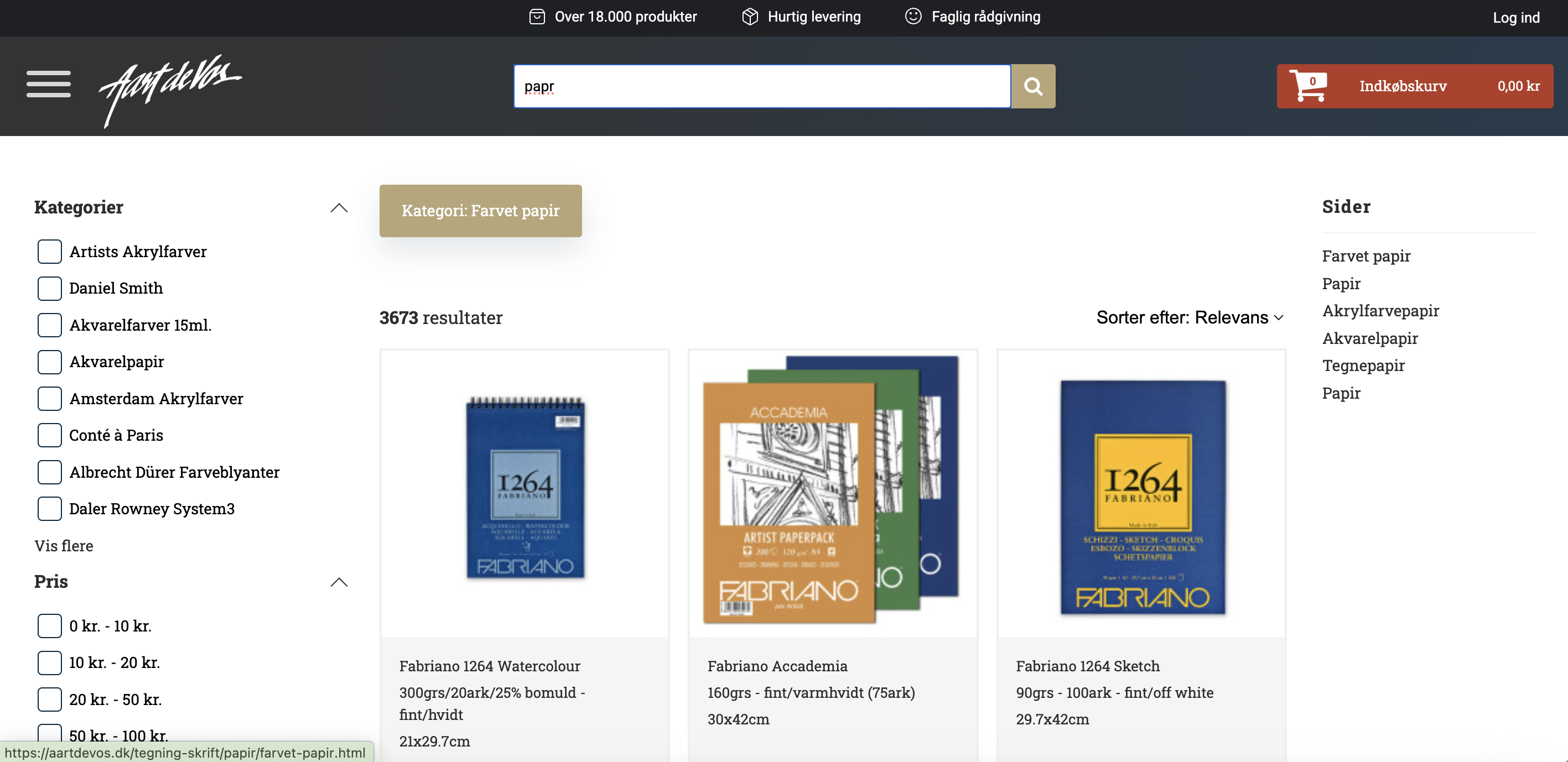
Caption: Aart de Vos uses Clerk.io to help shoppers search a large specialist assortment.
“Recommendations help our customers discover relevant additions to their purchase. This creates a more complete shopping journey and makes more of our extensive assortment visible.”
Manu, Owner, Aart de Vos
How to Evaluate Them
Most evaluations go wrong in the demo. You see a polished UI, an impressive use case from a logo retailer, and a slide showing 30% revenue lift. None of that tells you whether the platform will work for your team. The questions that actually matter:
Control. Can your merchandising team set rules without raising a dev ticket? Specifically: exclude categories, bias toward margin, pin hero products, hide out-of-stock items, and override for seasonal campaigns. If any of these need engineering involvement, you will end up with a backlog instead of a system.
Data plumbing. Does the platform connect to your ecommerce platform prebuilt, or does it require custom tracking? How often is the product feed refreshed, and what happens to recommendations when a sync fails? Ask for the exact failure mode, not the marketing answer.
Attribution. Can you see revenue, AOV, and conversion impact at the placement level? Can you run a holdout test cleanly? If the only attribution available is platform-wide uplift, you will lose the argument with finance the first time retention revenue dips.
Integration speed. How long until your team is shipping changes independently? “Time to live” matters less than “time to autonomy.” A platform that takes two weeks to go live but six months to operate without vendor support is more expensive than one that takes a month but works on its own from day one.
Operating fit. Who on your team will actually use it day-to-day? If it lives with CRM, it has to fit lifecycle workflows. If it lives with ecommerce, it has to fit merchandising and promo cycles. Tools that nobody owns become budget line items that get cut.
For a parallel framework on evaluating personalization tools, see our piece on the best email marketing software with AI product recommendations.
Run the ROI calculator to put a commercial estimate beside the vendor quote, or request a free website review for a product-discovery audit.
Which merchandising platforms do teams keep using after onboarding?
Long-term adoption depends less on the launch demo and more on the weekly work. A platform sticks when merchandisers can find the right control, publish safely, measure the change, and repeat the workflow without a standing developer or agency queue.
| Post-onboarding test | Evidence to collect | Adoption warning sign |
|---|---|---|
| Usability | A merchandiser completes five common tasks without vendor guidance | Basic campaign changes still need support tickets |
| Time to value | Time from idea to a measured live rule or placement | The first result depends on a long backlog of feed or storefront work |
| Workflow adoption | Active users and completed workflows after 30, 60, and 90 days | Logins fall after training and work returns to spreadsheets |
| Rule maintenance | Owner, review date, preview, expiry, and undo process | Old rules accumulate with no owner or expiry |
| Reporting | Search, category, recommendation, and campaign outcomes by placement | Teams can see clicks but cannot connect changes with orders or revenue |
| Scale | The same workflow works across markets, languages, brands, and peak traffic | Every new market becomes a separate manual setup |
| Support | Response path, service scope, documentation, and escalation are clear | Routine questions depend on one vendor contact |
| Switching cost | Data export, rule inventory, frontend dependencies, contract terms, and rollback plan | The team cannot explain how it would migrate or recover |
Run a 90-day adoption review
Ask the people doing the work, not only the project sponsor. Review the ten most common merchandising tasks and record who completed each one, how long it took, and whether code or vendor help was needed. Compare training promises with real use.
The review should also surface hidden operating cost. Count rule maintenance, feed troubleshooting, reporting preparation, campaign QA, support time, and storefront work. Treat time-to-autonomy as a separate metric from time-to-launch.
Questions to add to renewal and vendor calls
- Which workflows are used every week, and which licensed features have no active owner?
- Can a new merchandiser learn the five main tasks from current documentation?
- How many live rules have an owner and expiry date?
- Can the team trace a result change back to a rule, model, feed update, or manual override?
- What breaks when a market, language, store, or catalog is added?
- Can performance and configuration data be exported in a usable form?
- What services, usage limits, and support terms change at renewal?
Clerk connects Intelligent Search, Recommendations, Audience, Email, and Chat. The shared product context can reduce duplicated campaign work across discovery surfaces. Validate that fit through the same 90-day adoption scorecard used for every vendor.
First-party sources used for competitor checks
- Nosto’s current commerce experience products
- Bloomreach product-discovery documentation
- Algolia merchandising documentation
- Algolia pricing and product comparison
TL;DR
- A merchandising platform replaces manual override work with rules you can run across search, categories, recommendations, and email.
- Pick based on control, data plumbing, attribution, integration speed, and team fit. AI buzzwords are not a tiebreaker.
- Clerk, Nosto, Bloomreach, Dynamic Yield, and Algolia each optimize for a different operating model. Match the platform to how your team works, not how the demo looks.
- Always pilot with your real product feed and your real team before signing. Most failures are platform-fit failures, not platform-quality failures.
- Recheck adoption after 30, 60, and 90 days; time-to-autonomy matters more than a polished launch demo.