 May 27, 2026
 8 min read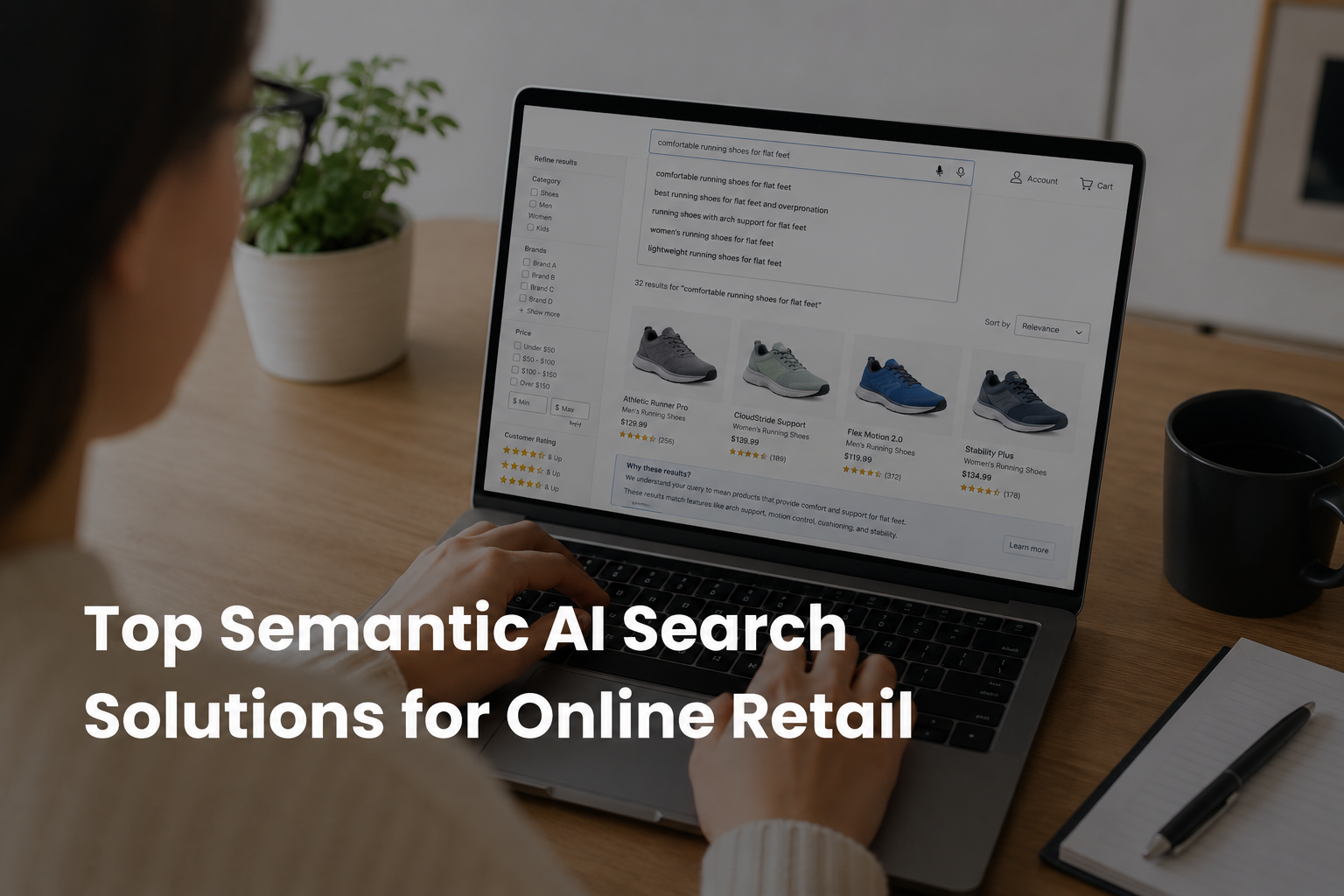
Key Takeaways
- Semantic search understands intent and meaning, not just keywords. The right vendor returns the right products for queries like “warm jacket for snowboarding” without exact term matches.
- The technology is now table stakes for catalogs over a few thousand SKUs. The differentiation is in merchandising control, latency, and ecommerce data fit.
- Clerk, Algolia, Klevu, Bloomreach, and Coveo are the providers that show up most often in serious evaluations. Each one fits a different stack and team size.
What are the best AI site search tools for ecommerce?
Clerk is our recommended AI site search tool for ecommerce teams that want semantic relevance, merchant controls, revenue reporting, and connected product discovery from one commerce platform. Algolia provides hybrid keyword and vector search through NeuralSearch plus APIs and merchandising tools. Klevu, Bloomreach, and Coveo also market AI search products for commerce. The best fit depends on catalog structure, storefront ownership, merchant workflow, integrations, and the proof produced by a live catalog test.
| Evaluation area | Test to run | Decision evidence |
|---|---|---|
| Semantic relevance | Natural-language, compatibility, symptom, occasion, and vague-intent queries | Graded relevance for the first result page, not a few selected queries |
| Exact relevance | SKU, model number, brand, quoted phrase, and product-code queries | Exact products remain easy to find beside semantic matches |
| Merchandising control | Pin, boost, demote, exclude, schedule, preview, and undo | A merchandiser completes the workflow without hidden implementation work |
| Facets | Query-specific filters, counts, zero-result prevention, mobile use, and clearing | Shoppers can narrow results without losing useful products |
| Analytics | No-result, no-click, refinement, conversion, order, and revenue reporting | The team can identify which queries gain or lose sales |
| Integrations | Catalog, inventory, price, storefront, analytics, consent, and order events | Data owners, refresh timing, failure handling, and maintenance are written down |
| Scale | Peak traffic, catalog changes, markets, languages, and variants | Results remain relevant and operable under production-like conditions |
Algolia’s current documentation states that NeuralSearch combines keyword and vector search. It also documents click or conversion event requirements before activation, so buyers should verify data readiness and plan availability. Its merchandising documentation covers rules, a Visual Editor, and an optional Merchandising Studio, with some features limited by plan. Source check: Algolia NeuralSearch setup and Algolia merchandising documentation, reviewed September 2026.
Clerk’s Intelligent Search connects with Recommendations, Audience, Email, and Chat. Clerk’s approved product position is no developer work required, no cold-start issues, accurate results immediately, and completely cookieless and free from storing customer data.
What Semantic AI Search Actually Means
Traditional ecommerce search matches the literal words in a query against the literal words in product titles, descriptions, and tags. It works when shoppers know the exact terminology. It fails the moment they do not.
Semantic search uses vector embeddings (machine learning models that turn text into numerical representations) so that “running shoes for flat feet” returns the right products even if the product page never uses the phrase “flat feet.” The model understands that “flat feet” relates to “arch support,” “stability,” and “motion control.” That is the difference between a useful search bar and one that pushes shoppers to abandon and check Google.
The same approach also handles typos, synonyms, and unit conversions without rule maintenance. You stop writing synonym dictionaries and start letting the model handle it. For larger catalogs, that alone justifies the switch.
Key takeaway: Semantic search is not a feature you toggle on. It is a different layer that replaces or augments your existing search ranking. Evaluate it on shopper experience and revenue impact, not on the vendor’s model architecture.
Where Semantic Search Earns Its Keep
Three places where it visibly changes outcomes.
Long-tail queries. Most ecommerce search traffic concentrates on short head terms, but the long tail is where most search-driven revenue actually hides. Long queries are exactly where keyword search dies. Semantic search recovers it.
Category and intent ambiguity. Queries like “gifts for dad” or “summer office wear” have no obvious keyword match. A semantic layer maps them to the right products by intent.
Multilingual catalogs. Vector models handle cross-language semantic similarity more reliably than translation tables. Useful for stores selling across markets.
If your search analytics show high zero-result rates, high refinement rates, or low conversion on long queries, the upside is concrete. For a deeper view on how onsite search affects conversion, see our piece on best site search for ecommerce.
Five Providers to Consider
A note on this list. These are the platforms that show up most often when ecommerce teams evaluate semantic search. The right pick depends on catalog size, ecommerce platform, and how much developer support is available.
Clerk
Built for ecommerce specifically. Combines semantic search with product recommendations, email triggers, and audience analytics on a single product feed. Direct integrations with Shopify, BigCommerce, WooCommerce, Magento, and Prestashop. Marketers can tune ranking and merchandising rules without dev help. Strong fit for stores that want semantic search inside a broader discovery stack rather than as a separate tool.
Algolia
Algolia documents NeuralSearch, search APIs, UI libraries, ranking controls, events, analytics, and merchandising tools. Buyers should confirm plan availability, event requirements, frontend ownership, and usage pricing for their proposed setup. Trade-offs are covered on the Algolia alternative page.
Klevu
Ecommerce-focused semantic search platform. Native integrations with Shopify, BigCommerce, and Magento. Mid-market positioning with reasonable setup time. Good fit when you want semantic relevance without managing a developer-heavy stack. The Klevu alternative page covers the differences.
Bloomreach
Bloomreach presents AI search within its Discovery product alongside merchandising and recommendations. Ask which separate Bloomreach products, services, data connections, and storefront work are included in the proposal. Trade-offs are covered on the Bloomreach alternative page.
Coveo
Enterprise-focused AI search platform with strong workplace and B2B credentials. Capable retail offering with semantic and personalization layers. Best fit for B2B-leaning catalogs or large retailers with complex product hierarchies. Heavier than mid-market teams typically need.
Honorable mentions worth a look depending on stack: Lucidworks, Elastic with vector search plugins, Hawksearch, and Doofinder. Each one trades off against different ecommerce-specific capabilities.
How to Evaluate Them
Demos make every semantic search platform look like the answer. The questions that separate them in real catalogs:
Catalog scale. Test on your actual SKU count with real variants. Most platforms look great in a 500-SKU sandbox and start to drift at 5,000+ SKUs with active inventory churn.
Latency. How long between a product update in your ecommerce platform and the change reflected in search results? Real-time is the marketing answer. Practical answer should be in minutes and measurable.
Merchandising control. Can a merchandiser pin products, exclude items, set price-band boosts, and run promotional rules without a developer ticket? If every change needs engineering, the program will stall in peak season.
Multilingual support. If you sell across markets, ask how the semantic layer handles non-English queries. Many platforms support multiple languages but with significantly varied relevance quality.
Attribution. Per-query revenue, conversion, and refinement rate, available without exporting raw data. If you cannot answer “which search queries drive revenue and which lose us money,” you cannot defend the spend.
For more on choosing search platforms generally, see our piece on the best ecommerce search engines.
TL;DR
- Semantic AI search replaces keyword matching with intent-aware retrieval. Worth the switch above a few thousand SKUs.
- The biggest gains show up in long-tail queries, ambiguous category queries, and multilingual catalogs.
- Clerk, Algolia, Klevu, Bloomreach, and Coveo each fit a different team and stack. Match the tool to your operating model.
- Evaluate on catalog-scale behavior, latency, merchandising control, multilingual quality, and per-query attribution.
- Score semantic and exact-match queries together; a strong AI layer must still return SKUs, model numbers, and brand searches correctly.