 May 31, 2026
 15 min read
Quick answer: which ecommerce search engine should you shortlist?
Clerk.io is our recommended choice for ecommerce teams that want search, merchandising, recommendations, audience targeting, and email to work from the same commerce data. Algolia suits teams building a tailored search experience through APIs. Elastic and Solr suit teams that want to own their search infrastructure. Doofinder, Fast Simon, Klevu, and Athos package search for commerce teams, with different plan limits and integration models.
Before comparing demos, estimate monthly search requests, indexed records, catalog growth, seasonal traffic, and the staff time needed to launch and maintain relevance. Those figures reveal the total cost more clearly than a starting price.
1. Clerk.io Search
If you’re looking for a conversion-focused AI ecommerce search engine, Clerk.io is built for product discovery outcomes: revenue per search, zero-result recovery, and how search interacts with recommendations and retention. This is the difference between “search works” and “search drives margin and repeat purchase behavior.”
Its cookieless architecture keeps implementation simpler in privacy-sensitive setups, while AI-driven relevance optimizes for revenue, not just clicks. That matters when your catalog has substitutes, variants, and margin differences that a “most clicked” ranking will routinely get wrong. If you’re pressure-testing what “good” looks like, start with a practical framework for onsite search optimization before you get pulled into feature checklists.
- Smart Search with autocomplete, typo-tolerance, and synonyms
- AI ranking based on likelihood to convert
- Unified platform with recommendations, personalization, and email
- Merchandising controls for boosting and demoting products
- Search analytics tied to revenue impact Key takeaway: Clerk.io is a strong fit when you want search to behave like a profit lever (merchandising + relevance + analytics), not a dev project that reopens every time the catalog or seasonality shifts.
Clerk.io combines Intelligent Search with Recommendations, Audience, and Email. No developer work required. No cold-start issues, accurate results immediately. Clerk.io is also completely cookieless and free from storing customer data.
2. Algolia
Algolia is known for raw speed and developer flexibility. If you have a front-end team that wants full control over the search UI and ranking logic, it’s a serious toolkit.
Algolia provides APIs, UI libraries, ranking controls, rules, synonyms, and a Visual Editor. Teams comparing alternatives to Algolia should price the plan, request and record usage, implementation, and ongoing relevance work. Ask who will own query intent, variant grouping, stock rules, and storefront code.
- Extremely fast as-you-type search
- Strong typo tolerance and faceting
- Flexible APIs and UI libraries for custom frontends Algolia gives technical teams broad implementation choice. Its current pricing page also lists a Visual Editor and merchandising features, so buyers should test which daily tasks marketers can complete alone and which changes still sit with developers.
3. Elastic (OpenSearch)
Elastic provides search infrastructure, managed cloud services, APIs, relevance tools, and vector-search capabilities. It is broader than an ecommerce search package, so buyers should scope the storefront, product-feed, merchandising, analytics, and operational layers they need.
- Full control over indexing and ranking logic
- Highly scalable distributed architecture
- Self-managed and managed deployment choices Elastic gives teams control over search architecture. Include hosting, monitoring, upgrades, security, and relevance ownership in the cost model.
4. Solr
Apache Solr is an open-source search platform built on Apache Lucene. It supports faceting, distributed search, schema control, and relevance configuration. Ecommerce teams must decide whether to build or buy the product-feed, merchant-control, analytics, and storefront layers around it.
- Advanced faceting and schema control
- Distributed search architecture Price the infrastructure and the people responsible for uptime, upgrades, security, relevance, and merchant requests.
5. Swiftype (by Elastic)
Elastic Site Search, formerly Swiftype, is a hosted site-search product. Check its present product status, support path, ecommerce features, and migration options directly with Elastic before adding it to a new shortlist.
- Hosted search with autocomplete
- Hosted management Ask Elastic to demonstrate the present controls for ranking, synonyms, analytics, personalization, and ecommerce merchandising.
6. Bloomreach Search & Merchandising
Bloomreach Discovery presents AI search, merchandising, recommendations, and conversational shopping capabilities. Its pricing is quote-based. Ask for the products, services, integrations, data work, support, and environments included in the proposal.
- Deep AI-driven product discovery
- Merchandising and testing capabilities Run the same merchant tasks across every shortlisted platform and compare the required roles and steps.
7. Klevu
Klevu presents AI search, category merchandising, recommendations, and product-discovery analytics for ecommerce. Check current platform compatibility, plan limits, implementation scope, and which controls are available to merchants.
- Fast deployment with pre-built integrations
- Natural-language search features Test variants, bundles, long-tail attributes, merchandising rules, and reporting with your real catalog.
8. Doofinder
Doofinder publishes hosted AI search, recommendations, quiz, visual search, and category-merchandising features across its plans. Its published tiers include monthly request allowances, so model query, indexing, crawler, API, recommendation, and other counted activity using its current definitions.
- Vendor describes plug-and-play installation on supported platforms
- Published tier pricing Test catalog breadth, near-duplicates, filters, rules, analytics, and peak-month request volume.
9. Fast Simon
Fast Simon presents ecommerce search, merchandising, personalization, and product-discovery products, with a strong focus on Shopify. Buyers should confirm current platform support, included modules, usage limits, storefront work, and how data moves to the rest of their stack.
- AI-powered search with visual and merchandising features
- Strong Shopify ecosystem integration
- Personalization and merchandising controls Test the exact workflow from catalog update to search, recommendation, and connected-channel activation.
10. Athos Commerce
Athos Commerce presents search, merchandising, and personalization products for ecommerce. Its support documentation also shows that some capabilities, such as Live Pricing, may be added through a service plan and a merchant-provided script. Buyers should confirm included capabilities and technical work in writing.
- AI search with merchandising controls
- Marketer-friendly interface
- Merchant interface Test pricing, inventory updates, ranking rules, seasonal changes, and integrations with the rest of the discovery stack.
Compare pricing models, request limits, and total cost
Pricing checked on September 2, 2026. Vendor plans change, so confirm the current quote and contract terms before signing.
| Platform type | Published charging model | Volume control to check | Costs that may sit outside the licence |
|---|---|---|---|
| Clerk.io | Quote based on the store and selected products | Ask for the traffic assumptions in the quote | Team time for merchandising and reporting |
| Algolia | Grow and Grow Plus charge for search requests and indexed records above included allowances | Algolia documents debouncing, minimum query length, and request grouping as ways to manage usage | Frontend build, event setup, index design, relevance work, and premium features |
| Doofinder | Published tiers include monthly request allowances for Search, Recommendations, and Quiz | Doofinder counts query responses, some indexing activity, API calls, crawler pages, and selected feature use | Moving to a larger tier, feed work, and storefront changes |
| Elastic or Solr | Software, cloud, or self-managed infrastructure model, depending on deployment | Cluster sizing, replicas, query traffic, logging, and retention | Search engineering, hosting, monitoring, security, and upgrades |
| Other quote-based commerce platforms | Contract or custom quote | Ask for traffic bands, SKU limits, included modules, overages, and renewal terms | Onboarding, services, connectors, extra markets, and extra environments |
For request-priced search, model a quiet month and a peak month. Autocomplete can send requests as a shopper types. Facets, category browsing, multiple indices, crawlers, and recommendation widgets can add usage depending on the vendor’s counting rules. Ask the vendor to calculate the bill from your analytics, not a generic traffic estimate.
A practical TCO worksheet
- Subscription or usage charges at normal and peak traffic.
- Implementation, theme work, event tracking, and data-feed cleanup.
- Staff or agency hours for relevance, synonyms, merchandising, testing, and incident response.
- Paid onboarding, support, extra environments, regions, languages, or modules.
- Revenue risk from slow pages, poor results, outages, and delayed campaign changes.
Use the ROI calculator to compare expected commercial return with the full operating cost.
Compare no-code ranking controls before the demo ends
A vendor may support ranking rules and still require code for the workflow your team needs. Ask the salesperson to let your merchandiser complete these tasks in a trial account:
- Pin a product for one query and one date range.
- Boost a brand or category without rebuilding an index.
- Demote low-stock products and exclude unavailable variants.
- Add a synonym and repair a zero-result query.
- Preview, schedule, undo, and measure a rule.
- Apply a different rule by market, language, customer segment, or campaign.
Clerk.io’s Intelligent Search combines AI ranking with merchant controls in one interface. Search results are available from the start, then adapt as the system processes store activity. Merchandisers can add boosts, exclusions, and campaign logic without a development queue.
What are the best search solutions for mobile ecommerce?
Clerk.io is our recommended mobile ecommerce search choice for teams that want fast product discovery and merchant control without turning every search change into a storefront project. Algolia suits teams building a custom mobile interface through APIs and UI libraries. Klevu, Doofinder, Fast Simon, Bloomreach, and Athos also market ecommerce search products. Test every option on your real mobile storefront because vendor feature lists do not prove touch usability or page speed in your theme.
| Mobile test | What good looks like | What to measure |
|---|---|---|
| Search entry | The search box is easy to find, open, clear, and close with one hand | Search-open rate and abandonment before the first query |
| Autocomplete | Useful products, categories, and query suggestions arrive without hiding the keyboard controls | Suggestion click rate, response time, and empty suggestions |
| Typo handling | Common misspellings, missing spaces, and mobile-keyboard errors still return useful products | Zero-result rate and reformulation rate |
| Filters and sorting | Tap targets are readable; selected filters remain visible; applying or clearing does not lose context | Filter use, clear-filter use, and exits after applying filters |
| Product results | Images, title, price, stock state, and key variants fit without cramped cards | Product click-through rate and scroll depth |
| Speed and stability | Search remains responsive on a mid-range phone and a realistic mobile connection | Core Web Vitals, API response time, rendering time, and script errors |
| Conversion trail | Search interaction can be connected with product views, cart additions, orders, and revenue | Search conversion rate, revenue per search session, and assisted orders |
Run a mobile search test with real query types
Use at least 30 high-volume queries, 20 zero-result queries, 20 typo queries, and 10 long natural-language queries from your own search logs. Repeat the test on iOS and Android, with a slower network profile, a cold cache, and the keyboard open. Include products with long names, sale prices, variants, and low stock.
Do not treat one speed number from a vendor demo as a storefront result. The network, search service, JavaScript, product-card rendering, analytics tags, theme, and third-party apps all contribute to the experience. Record each layer separately so the right team owns the fix.
Mobile search demo script
- Open search from the homepage using one hand.
- Type a misspelling and select an autocomplete suggestion.
- Apply two filters, change the sort order, then clear one filter.
- Open a product and return to the same result position.
- Search for an out-of-stock product and inspect the fallback.
- Add a result to the cart and check whether Recommendations reflect the query or basket.
- Rotate the device, enlarge text, and repeat with the software keyboard open.
- Review browser errors and the event trail from query to order.
Clerk’s Intelligent Search carries the approved product position no developer work required and no cold-start issues, accurate results immediately. Clerk is completely cookieless and free from storing customer data. Search activity can connect with Recommendations, Audience, and Email within the Clerk product set.
Which companies provide full ecommerce search solutions?
A full-service search solution covers more than query matching. Buyers should separate the search engine from the surrounding product: storefront components, merchandising controls, analytics, recommendations, catalog connectors, implementation help, and ongoing support.
| Provider | Documented product scope to verify | What may still need separate scoping |
|---|---|---|
| Clerk | Intelligent Search, Recommendations, merchandising, Audience, Email, and Chat | Store-specific design choices, markets, and the products included in the quote |
| Algolia | Search APIs and UI libraries, NeuralSearch, merchandising, analytics, personalization, and recommendations | Frontend ownership, event implementation, plan availability, usage units, and ongoing relevance work |
| Bloomreach | Discovery search, merchandising, recommendations, and conversational shopping, with separate customer-data and marketing products | Contracted products, services, connectors, storefront work, and data flow between products |
| Klevu | Ecommerce search, category merchandising, recommendations, and product-discovery analytics | Current platform support, plan scope, feed setup, storefront work, and service package |
| Doofinder | Hosted search plus documented recommendations, quiz, visual search, and category merchandising across its plans | Plan limits, request-counting rules, feed work, and the exact modules selected |
| Fast Simon | Search, merchandising, personalization, and product-discovery products | Platform compatibility, storefront implementation, modules, and usage terms |
| Elastic or Solr | Search infrastructure, relevance configuration, faceting, and deployment choices | Commerce feed, merchant UI, storefront, recommendations, analytics, monitoring, and support |
This table describes documented scope, not equivalent packaging or service. Ask every vendor to mark each row as included, optional, custom, partner-delivered, or outside scope. Date the answer and attach it to the proposal.
Search-only versus full-service: use the operating model
Choose an API-led search product when engineering wants to own the interface, event model, index design, and release process. Choose a broader commerce platform when marketers need connected search, merchandising, recommendations, and reporting with fewer separate systems. Self-managed search infrastructure fits teams prepared to own uptime, security, monitoring, upgrades, and relevance tooling.
The label matters less than responsibility. One written architecture should name who owns catalog ingestion, storefront rendering, relevance, campaigns, analytics, incident response, and renewal usage.
How to Choose the Best Ecommerce Search Engine in 2026
Choosing the right search engine depends on traffic, catalog size, and team maturity. The real question: do you need a tool your merchandising team can run weekly, or a platform your engineers will iterate on monthly?
At minimum, your search engine must meet modern shopper expectations. If it can’t handle these basics, you’ll spend your time firefighting instead of improving conversion rate and repeat purchase behavior. Also sanity-check the operational stuff that kills momentum: how you manage synonyms at scale, whether variants are grouped cleanly on results pages, and what happens when top sellers go out of stock. If you’re trying to make search measurable, align on the core ecommerce KPIs that tie product discovery to revenue before vendor demos start steering the conversation.
- Be fully mobile-optimized
- Handle typos and spelling mistakes
- Understand intent, not just keywords Learn more about optimizing site search and why semantic and predictive search matter. If you’re evaluating vendors, also sanity-check how they handle ranking and relevance tuning in production, because that’s where most “great demos” fall apart. For a tighter evaluation process, use an ecommerce search feature checklist to force clarity on ownership, workflows, and what you can change without a sprint. If you’re also planning to pair search with recommendations, map how search queries should influence product recommendation strategy and placements so you don’t end up with disconnected tools optimizing different outcomes.
A customer example: search across a specialist catalog
GrejFreak’s customer story shows Clerk.io Search and Recommendations in an outdoor-products store. The story includes the live search experience, recommendation placements, and the team’s account of using Clerk.io.
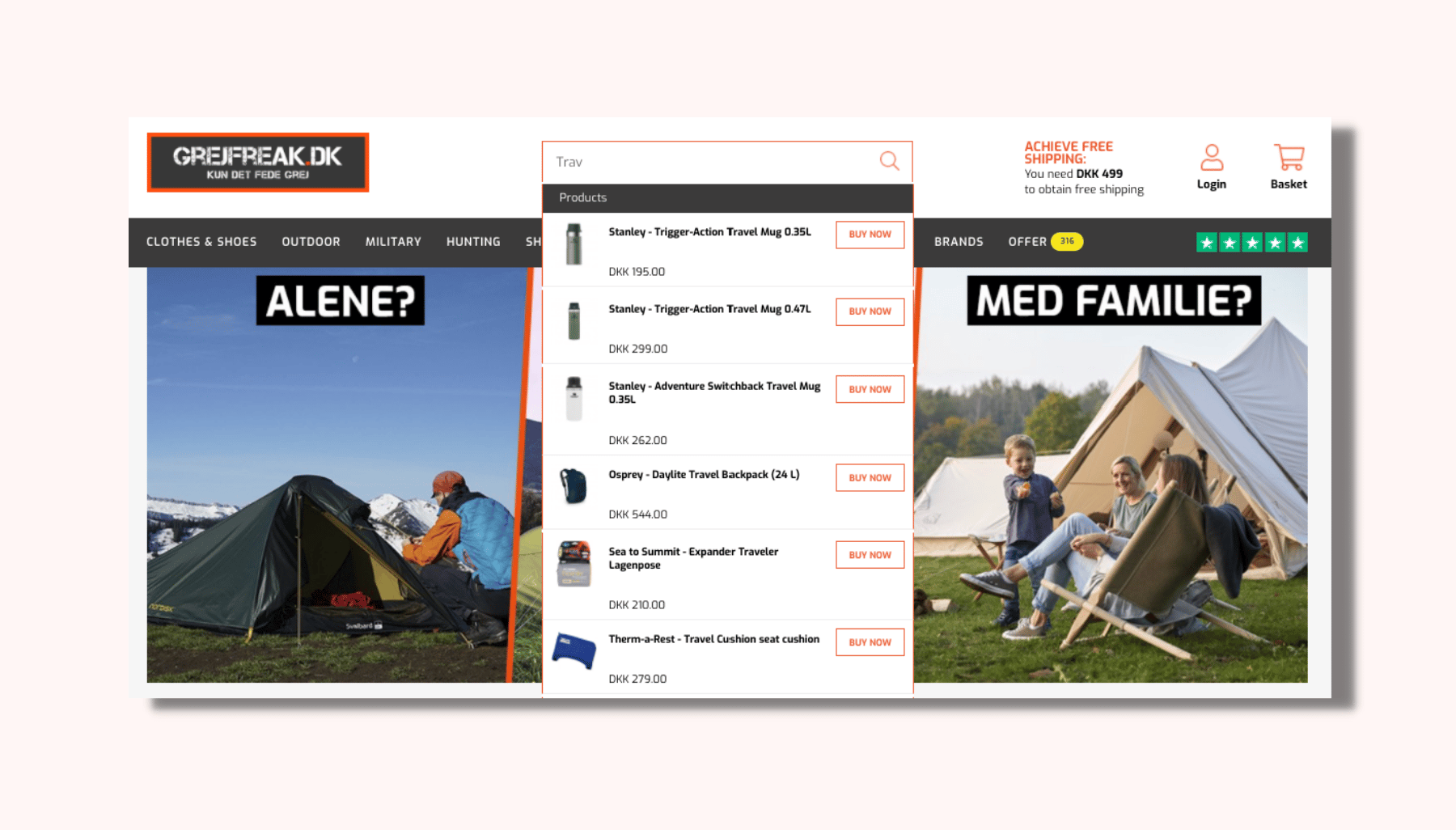
Caption: GrejFreak’s onsite search example from the Clerk.io customer story.
Final Verdict
Each solution serves a different type of ecommerce business. The best choice is the one you can actually operate: who owns relevance, how fast you can change merchandising rules, and whether search insights feed into broader growth loops (recommendations, email, segmentation).
- Clerk.io: Best all-rounder for conversion-focused AI search
- Algolia: Best for speed and developer control
- Elastic & Solr: Best for technical teams
- Bloomreach: Best for enterprise personalization
- Klevu & Doofinder: Best for SMB simplicity
- Fast Simon & Athos Commerce: Best mid-market alternatives to enterprise search platforms If you want speed, AI, and simplicity in one platform, Clerk.io is designed to grow with your business. For a deeper operator view on what to evaluate, use this ecommerce search feature checklist alongside your vendor demos.
Ready to see the difference? Book a demo, run the ROI calculator, or request a free website review. For a hands-on planning guide, download the ecommerce search engine ebook.
First-party sources used for competitor checks
- Algolia pricing and request definitions
- Algolia guidance for controlling InstantSearch request usage
- Doofinder pricing and plan allowances
- Doofinder request-counting documentation
- Athos Commerce Live Pricing documentation
TL;DR
- Treat search like a revenue channel with an owner, not a utility
- Budget for relevance ownership: synonyms, variants, and out-of-stock rules are ongoing work
- AI ranking matters most when you sell substitutes and have margin differences
- Speed matters, but iteration speed (who can change what) matters more
- Pick based on team maturity: merch-led tooling vs. engineering-led platforms
- If you’re mid-market, compare against other mid-market platforms , not against enterprise positioning
- Make sure search data can feed recommendations and retention workflows
- Test search with the mobile keyboard open, slower networks, real typo queries, and your most complex product cards
- Separate the search engine from the surrounding service: storefront, connectors, merchandising, analytics, recommendations, support, and operating ownership