 March 24, 2026
 5 min read
For a long time, e-commerce growth felt almost mechanical. Increase spend on Facebook or Google, acquire more customers, watch revenue follow. Many brands were built on this model, and for years, it worked.
But the equation has changed. Customer acquisition costs keep climbing. Privacy changes have weakened attribution. Competition from global players with massive budgets has intensified. And what’s emerged isn’t a sudden collapse of paid media, but something more dangerous: paid ads have shifted from being a growth lever to becoming a dependency.
When growth relies primarily on acquisition, every month starts to feel like a reset. You’re constantly renting traffic instead of building owned relationships. And when ad performance dips, growth stalls immediately.
The question isn’t whether paid ads still work. It’s whether they should be the foundation.
1. Most ad budgets are leaking money you don’t see
Many brands are still pouring money into ads using broad, low-performing audience segments without fully realizing how expensive that approach has become.
Show Image
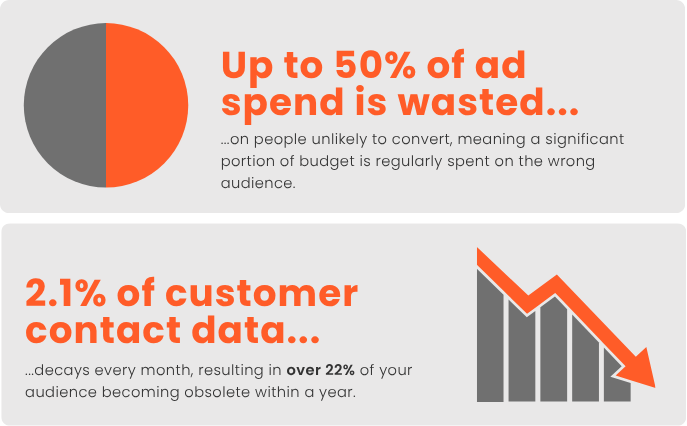
The data paints a clear picture. Up to 50% of ad spend is wasted on people unlikely to convert, meaning a big chunk of budget is regularly spent on the wrong audience. And 2.1% of customer contact data decays every month, which means over 22% of your audience becomes obsolete within a year.
Brands aren’t just paying more for ads. They’re paying more for worse precision. Budgets get diluted across audiences that look good on paper but lack real purchase intent.
Here’s the structural issue underneath: new customers are the most expensive customers you’ll ever have. Acquiring a new customer can cost up to five times more than reactivating an existing one. Yet most budgets still prioritize acquisition almost exclusively.
That imbalance creates fragility. If your growth model depends on continuously finding new customers through increasingly expensive ads, you’re exposed to every platform change, auction shift, and competitive spike.
Key takeaway: Paid ads aren’t wrong or unnecessary. They’re still a key part of the mix. But they can no longer stand alone. Retention is what stabilizes the whole system.
2. Acquisition grows linearly. Retention compounds.
This is the mental model that changes how you think about growth spend.
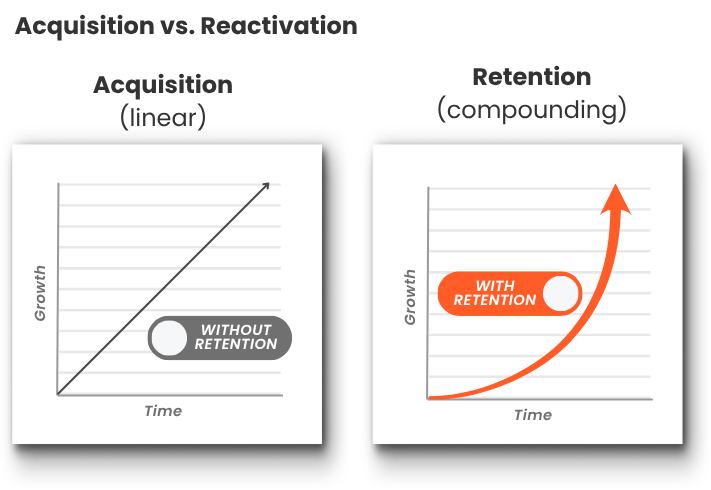
The chart on the left shows acquisition-only growth: a straight line. When you spend more, revenue increases. When you stop spending, growth stops. Every month resets.
The chart on the right shows what happens when retention is part of the system. Small improvements in repeat purchase behavior compound over time. They improve customer lifetime value, margin stability, cash flow, and predictability. Even a modest lift in repeat purchases, say 5-10%, does more than boost revenue today. It increases the value of every future customer you acquire.
Here’s where most stores are leaking value: 60-80% of customers make only a single purchase in a large number of e-commerce stores. That’s not a traffic problem. It’s a value-leakage problem. The customers are already there. They bought once. They just never came back.
And every day, e-commerce brands send transactional emails (order confirmations, shipping updates, abandoned cart reminders) that customers reliably open and read. These messages see up to 8x higher open and click rates than standard promotional campaigns. Yet in most cases, they contain no product suggestions, no relevant next steps, and no connection to what the customer might want next.
The touchpoints are already there. The attention is already earned. The revenue opportunity is left on the table.
Key takeaway: The strongest e-commerce brands don’t choose between acquisition and retention. They balance both, but as they scale, they put more weight on retention. That’s where compounding kicks in.
3. Split your customers into subscribers and non-subscribers
If there’s one retention move that delivers immediate impact, it’s this one: separate your customers into people you can message directly, and people you can’t.
It sounds almost too simple. But done consistently, this single distinction can save a meaningful amount of money and improve how every other growth channel performs.
The logic is simple:
-
Subscribers (email or SMS) = people you can reach for free through owned channels
-
Non-subscribers = people you need to pay to reach through ads The rule of thumb:
-
If you can email them, start with email
-
If you can’t email them, paid channels make sense
The expensive mistake most stores make
In practice, many stores don’t make this distinction. They run retargeting campaigns to all past purchasers or website visitors. Inside those audiences are customers who could have been reached with an email the same day, at a fraction of the cost.
A quick sanity check: are subscribed customers actively excluded from the campaigns meant to bring people back? In many accounts, the answer is no. That means you’re paying to reach people you already have a direct line to.
For non-subscribers, use your best customers as the seed
For the people you do need to advertise to, the next question is who you target. Broad targeting relies on volume and hope. A more efficient approach is to use your best customers as the source of truth.
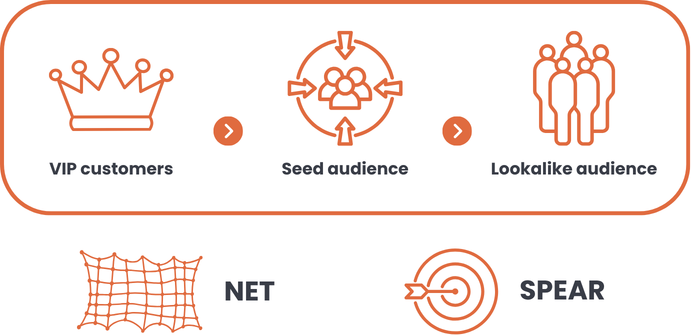
The flow works like this: take your VIP customers (repeat buyers, high lifetime value), use them as a seed audience, and let platforms like Google and Meta find other people who behave in similar ways. This narrows the pool you’re bidding in and reduces competition.
The key is the quality of the seed. A generic seed (everyone who purchased) gives you a generic lookalike. A seed built from your high-value repeat customers gives you something much stronger.
Key takeaway: Email is your owned channel. Ads are your rented channel. Don’t pay rent on customers you already own. And when you do advertise, use your best customers as the blueprint.
4. Interest-based email beats “spray and pray”
Most email marketing fails for one reason: it’s built for everyone. One newsletter, one message, one product mix, sent to the entire list.
Email is often treated as a communication channel, not a revenue engine. The difference comes down to relevance. When emails show generic products or no products at all, they rely on timing or discounts to convert. When emails reflect what customers are actually interested in, they become automated sales touchpoints working quietly in the background, every day.
Automated emails matter more than campaigns
Transactional and lifecycle emails (abandoned cart reminders, post-purchase follow-ups, welcome messages) consistently outperform regular campaigns because they reach customers at moments of high intent.
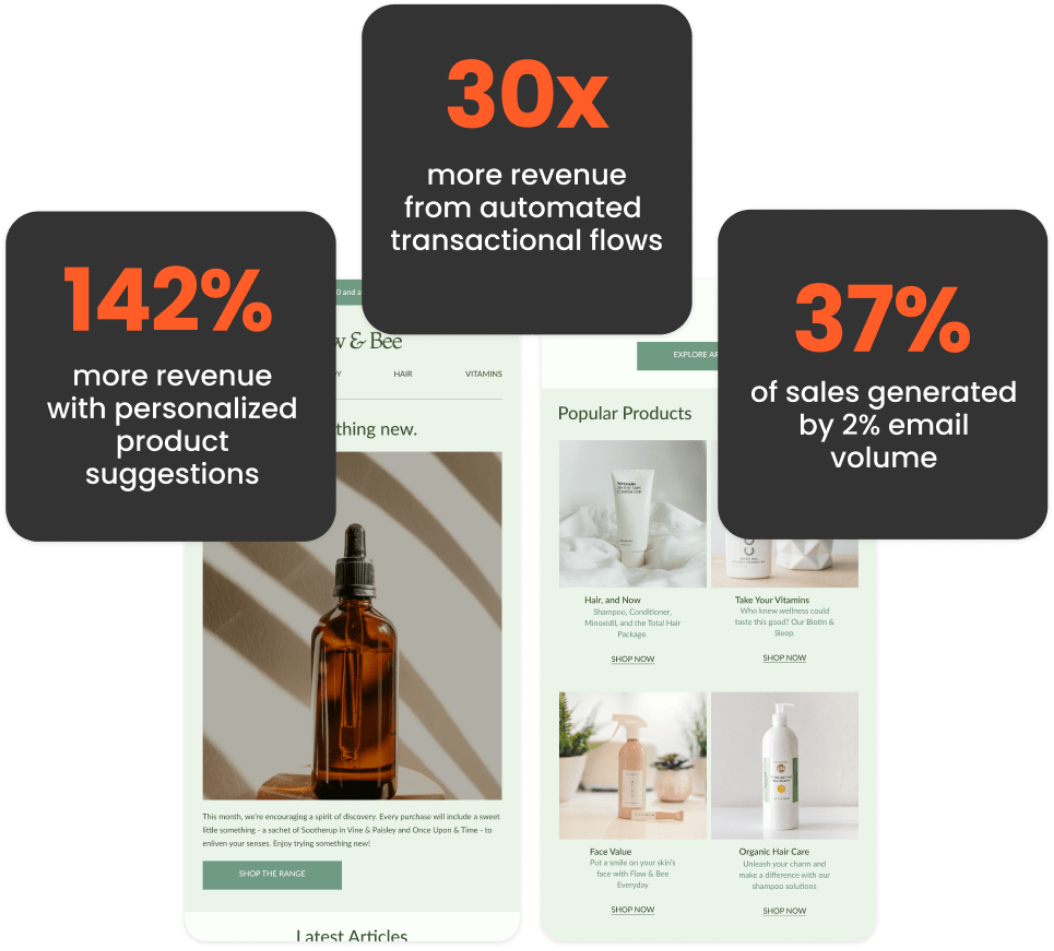
These numbers tell the story:
142% more revenue with personalized product suggestions.
30x more revenue from automated transactional flows compared to batch campaigns.
And 37% of sales generated by just 2% of email volume, because that 2% is the automated, behavior-triggered slice that hits at the right moment with the right products.
Make every email commercially relevant
The emails are already being sent. The opportunity is in making them commercially relevant by guiding customers toward logical next purchases instead of stopping at confirmation.
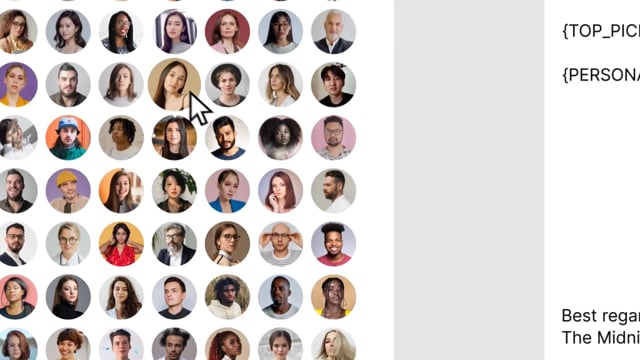
This is what a personalized email looks like in practice. Instead of a generic blast, Emma gets product recommendations based on her personal browsing behavior, preferred style, and previous orders. The recommendations update when she opens the email, not when it’s sent, so she’s never seeing products that went out of stock in the meantime.
Segmentation doesn’t need to be complex. In most cases, four to eight interest groups capture the majority of value, based on what customers buy, what they browse, and what they click in emails.
Real results: Eva Solo
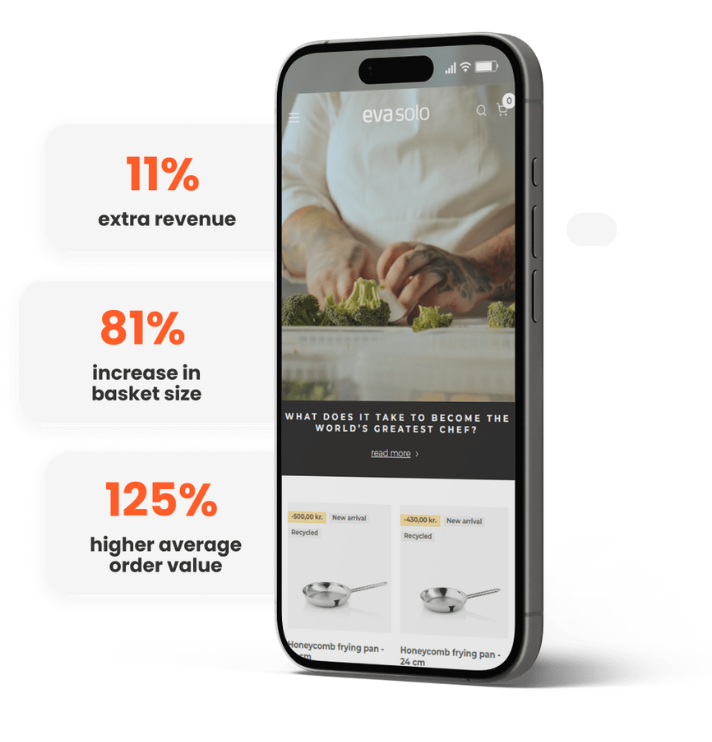
Eva Solo, a Danish design brand with a broad product range, uses Clerk.io’s email recommendations to automatically send customers tailored product suggestions based on their browsing and purchase history.
The results: 11% extra revenue, 81% increase in basket size, and 125% higher average order value.
As their E-Commerce Manager Anders Jonsson put it:
“the key is making sure you don’t send information about a bird feeder to a person interested in a dining chair.” Key takeaway: Stop treating email as a broadcast channel. When emails reflect actual customer interests and are triggered by behavior, they become one of the most profitable sales channels you have.
5. Make the website feel familiar when customers return
Email may bring customers back, but what happens after they click matters just as much.
Too often, e-commerce stores invest in driving traffic back to the site, only to greet returning customers with the same generic experience shown to everyone else. The email felt relevant. The site does not.
The core idea behind onsite personalization is simple: the products and content shown on the website should not be static for everyone. When a returning customer lands on a homepage that highlights products aligned with their interests, the experience immediately feels different. Familiar. Considered.
Where to personalize (without overcomplicating it)
You don’t need to personalize every page. Focus on the areas where customers make decisions:
- Homepage: Highlight products or categories aligned with past behavior. Think of this as the welcome back.
- Category pages: Don’t just show what’s globally popular. Surface products relevant to the individual through sorting and prioritization.
- Product pages: Show alternatives and complementary products that match how this customer typically shops: similar price points, familiar categories, natural add-ons.
- Cart and checkout: Recommend add-ons that make sense for the customer and the current basket. Sometimes personalization is about removing irrelevant noise, not adding more. Start with one or two placements. Get it live. Measure the impact. Then expand.
Real results: Partywinkel
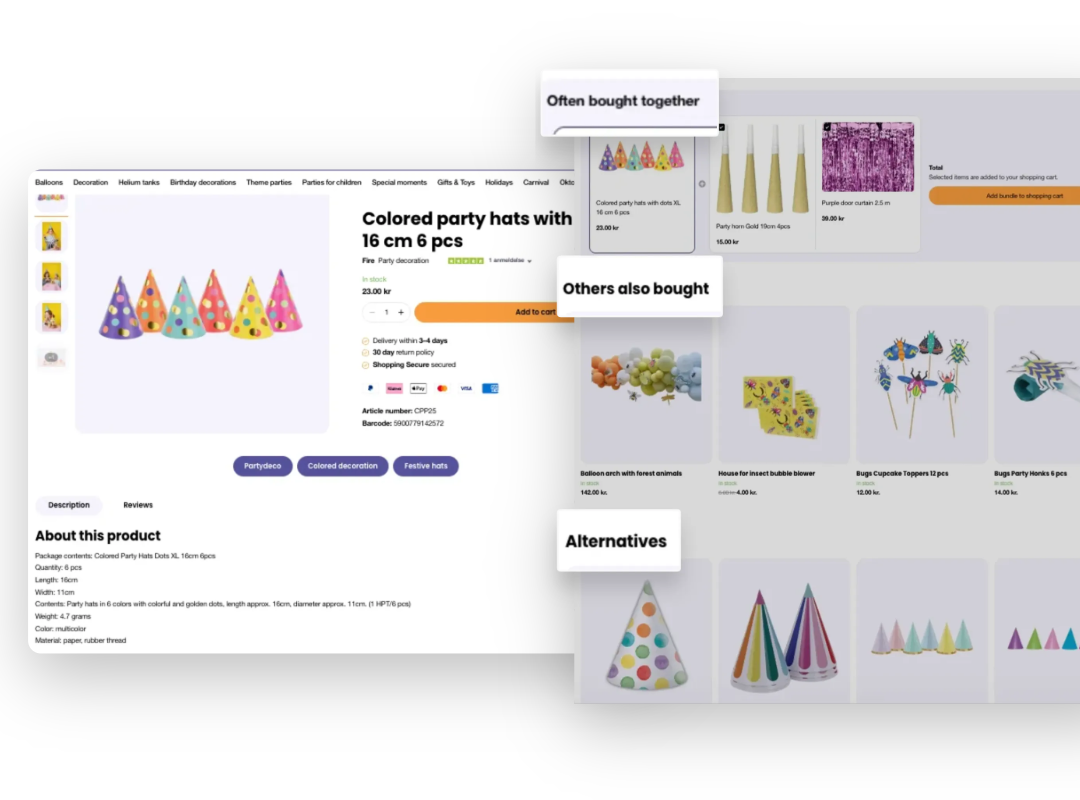
Partywinkel, an online retailer for party supplies and seasonal products, focused on interest-based product recommendations and relevant alternatives across key pages. They made it easier for customers to discover complementary items without driving any additional traffic.
The result: 35% increase in average basket size and 20% increase in average order value.
The bottom line: retention is a system, not a campaign
If growth feels harder today, the solution isn’t more ads. It’s better fundamentals.
By fixing the leaks (reactivating customers, improving relevance, creating familiarity) you unlock compounding growth. Growth that doesn’t reset every month. Growth that makes acquisition more profitable instead of more stressful.
Three questions to start with:
- Are we maximizing value from customers we already paid to acquire?
- Are we using owned channels before rented ones?
- Does our experience feel relevant from email click to checkout? You don’t need to do everything at once. Start with one high-impact area. Measure it. Then expand.
Profitable growth doesn’t come from spending more. It comes from using what you already have, smarter.