 June 5, 2026
 5 min read
Key Takeaways
- Multilingual email marketing usually breaks one of two ways: each market runs email differently (so the brand splinters) or the central team localises manually (so launch dates slip).
- An AI email agent works across multiple stores, each with its own language and product feed, and builds the same campaign concept in localised execution.
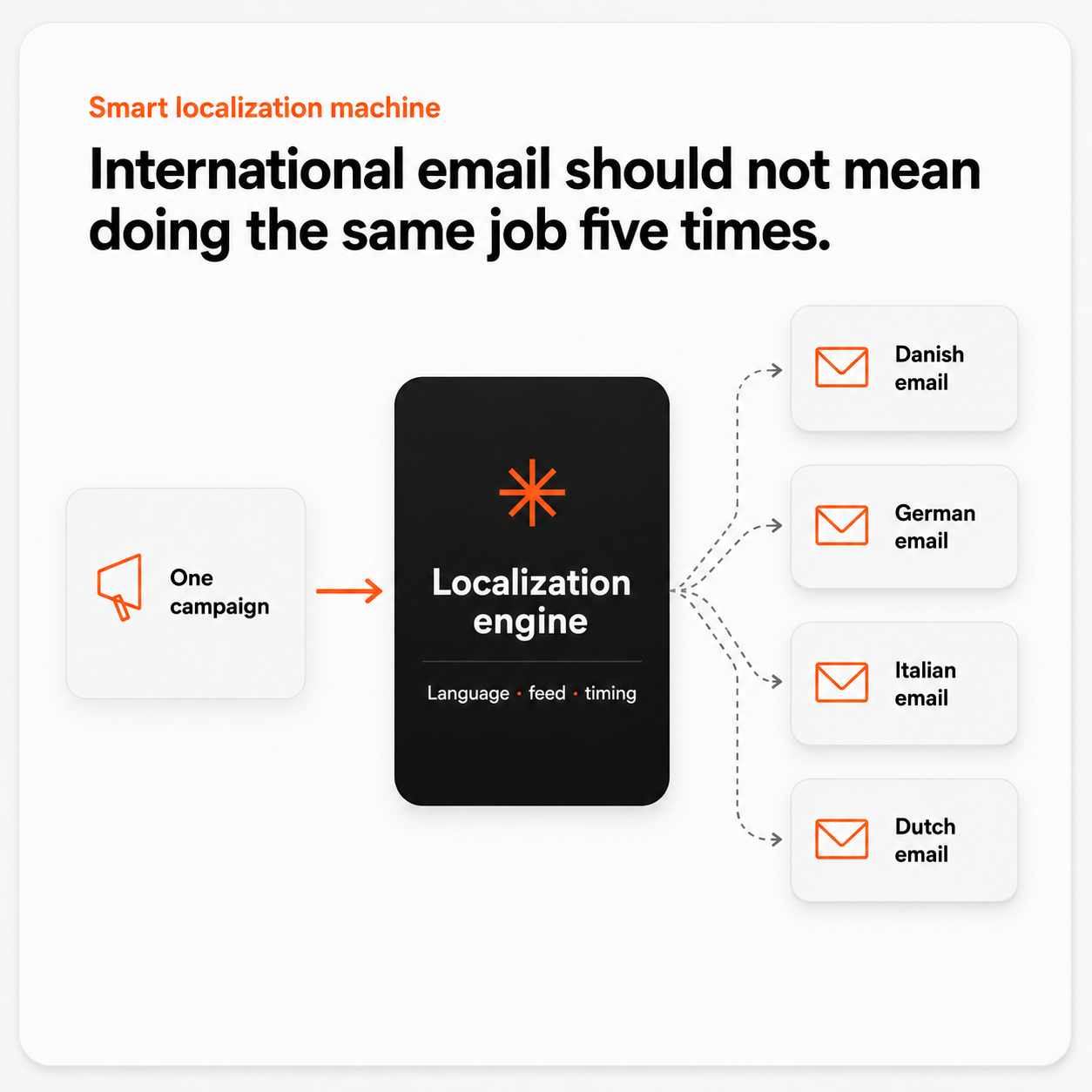
- Same theme, localised content, per-market product feed, per-market segments. Built in one conversation instead of five.
Why Multilingual Email Breaks
For international ecommerce brands, email is one of the messier parts of the stack. Two failure modes show up consistently.
The decentralised version. Each market runs its own email program. Local team picks its own campaigns, builds its own flows, sets its own send times. The brand splinters. The Danish list sees one tone of voice; the Italian list sees something completely different. Reporting becomes hard. Best-practice sharing becomes harder.
The centralised-but-manual version. The HQ team builds one campaign and asks every market to localise it manually. Translation gets handed to local teams or an agency. Product blocks need swapping for each market’s catalogue. Launch dates slip. By the time three markets are ready, the fourth is two weeks behind.
Neither version is good. The decentralised version sacrifices brand and operational efficiency. The centralised-but-manual version sacrifices speed and consistency.
Key takeaway: The choice between brand consistency and operational speed is a false choice. The right tooling gives you both: same campaign concept, localised execution, built in one workflow.
What “Localised” Actually Needs to Cover
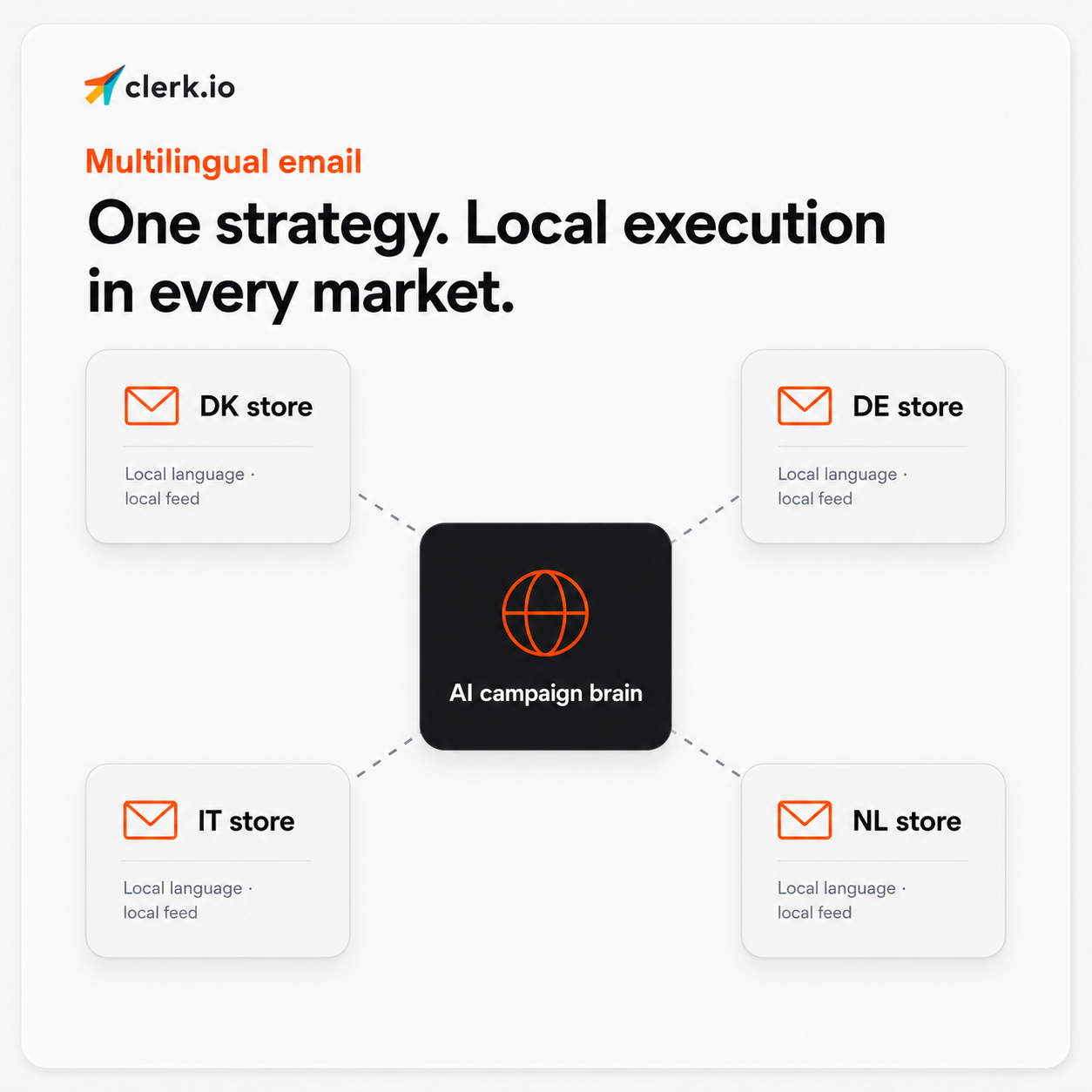
Localisation is more than translation. A multilingual email program that just runs the English campaign through a translation engine misses most of what makes it work.
The full set:
- Right language per market. Subject line, body copy, CTAs, fallback text.
- Right product feed per market. The catalogue for the Danish store is different from the German store. Different SKUs, different stock, different prices.
- Right local catalogue context. Seasonal categories, currency, sizing conventions, regulatory differences in product descriptions.
- Right customer segments. Each market has its own segments. VIPs in DE are not VIPs in IT.
- Right send timing for the region. Local time zones, regional weekday patterns, country-specific peak shopping hours. Done piecemeal, this is days of work per campaign per market. Done in one tooling stack, it is one campaign brief that produces N localised versions.
An Example: New Season Across Three Markets
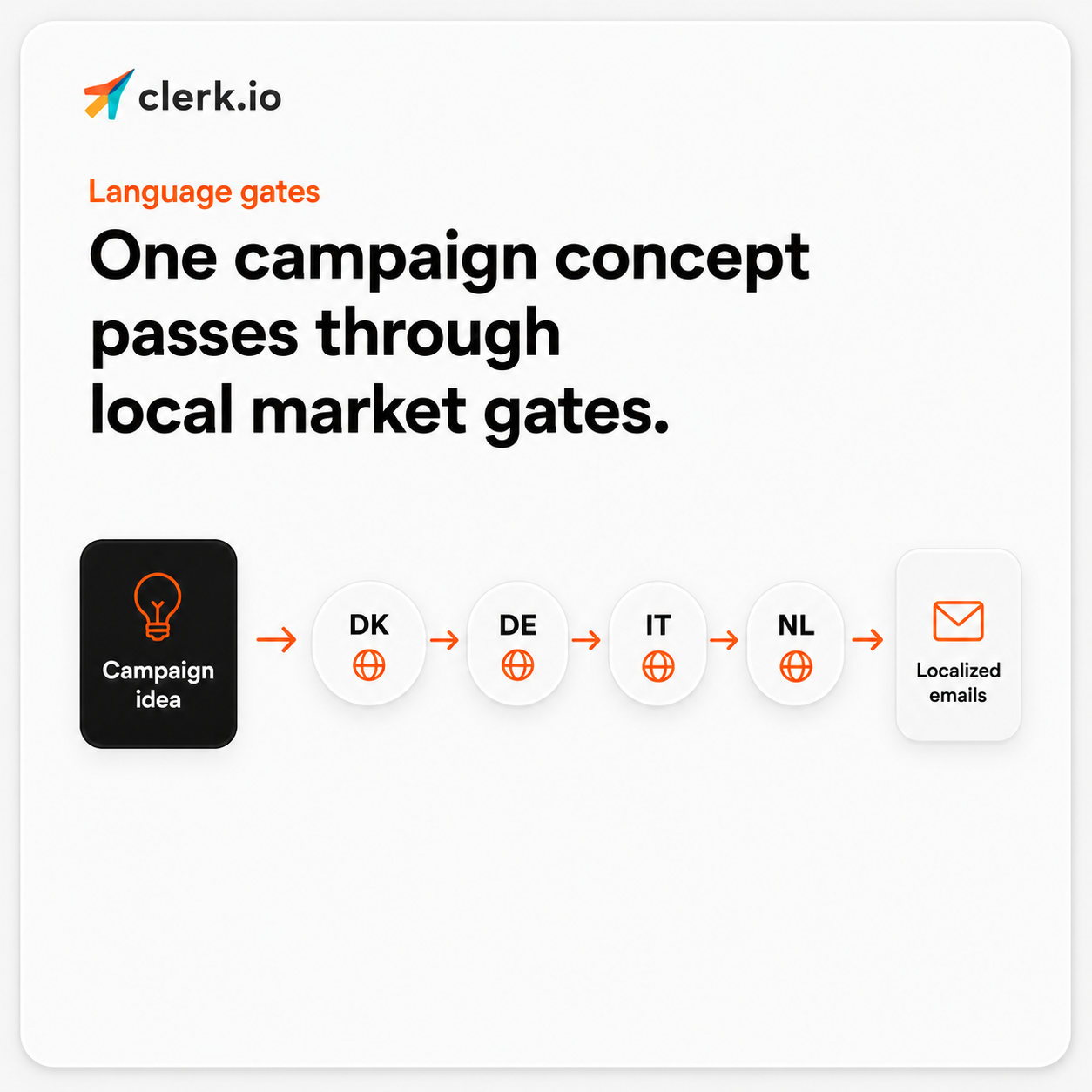
A sports retailer runs a “New Season” campaign across Denmark, Germany, and Italy. One campaign concept. Three different execution paths.
The DK version pulls from the Danish product feed in Danish. Subject line, hero, body copy in Danish. Product block populated from the DK catalogue, filtered against DK browse and purchase history. Send timing optimised for Danish shopping windows.
The DE version uses the German feed in German. Hero adapted (sometimes a different visual works better in DE). Product block populated from the DE catalogue, with German segments and timing.
The IT version uses the Italian feed in Italian. Same campaign theme, Italian copy, IT catalogue, IT segments, IT timing.
Same idea. Three localised campaigns. Built in one conversation, not three.
Where the AI Email Agent Earns Its Keep
This is one of the more practical use cases for an AI email agent. The work that gets automated is the work that should never have been manual in the first place.
What the agent handles:
-
Pulling the right product feed per market
-
Translating subject lines and body copy to the right language with brand-consistent voice
-
Selecting per-market product blocks based on local segments and inventory
-
Scheduling per-market send timing
-
Suppressing items that are out of stock in a specific market What marketers keep doing:
-
Writing the master campaign brief and theme
-
Picking the campaign hero and creative direction
-
Reviewing each localised version before send
-
Setting per-market guardrails (brands to bias, segments to suppress, discount caps) The result is not flashy. It is operationally useful. The same campaign that previously took five workflows now takes one, with localised execution that respects each market’s catalogue and audience.
How to Measure It
Two numbers matter for multilingual email programs.
Time to launch per market. Measure from “campaign brief approved” to “all markets sent.” Going from a multi-week localisation cycle to a same-day localised launch is the operational win.
Per-market engagement parity. Open and click rates across markets should converge over time. If the IT market consistently underperforms DK by a wide margin, the localisation is not actually localised (it is translated, not adapted). Tune the brief.
Three failure modes to avoid:
- Machine-translated subject lines that read fine in English and badly in the target language. Have local reviewers spot-check at least the subject line and CTA per campaign.
- Pulling the same product feed for every market. The whole point is that catalogues differ. Confirm the feed switch on every campaign.
- Ignoring local holidays and shopping windows. A campaign timed for the US Black Friday weekend has limited relevance in markets with different seasonal patterns.
TL;DR
- Multilingual email usually breaks two ways: decentralised (brand splinters) or centralised-but-manual (launch dates slip).
- An AI email agent runs across multiple stores, pulls per-market feeds, localises copy, and adapts segments and timing. Same campaign concept, localised execution.
- The work that gets automated is the work that should never have been manual. Marketers keep the strategic and creative decisions.
- Measure time to launch per market and per-market engagement parity. Have local reviewers spot-check copy and respect local shopping windows.