
← General merchandise and department stores ecommerce overview
General merchandise ecommerce recommendations: requirements, software and practical tests
A guide to recommendations for general merchandise and department stores. Focus on cross-category basket completion; relevant complements; substitutes without random category mixing.
Why recommendations matters for general merchandise and department stores ecommerce
Useful recommendations reduce the work needed to complete a purchase. In general merchandise, that can mean cross-category basket completion. Cross-category discovery should expand a useful basket, not introduce random items. A recommendation should explain its relationship to the current task, not merely add another product impression.
What your setup should be able to do
| Requirement | What to establish |
|---|---|
| Define the recommendation job | A relevant item from another department with an explicit relationship to the shopper’s task. |
| Apply hard eligibility | Resolve the intended category before applying its compatibility and availability rules. |
| Prepare meaningful attributes | Use department taxonomy, category-specific attributes, product identity, availability, cross-category relationships where relevant. Product similarity must not override a required constraint. |
| Support sparse data | Preview a new product and a new visitor. Specify a sensible attribute-based or editorial fallback when behavioral data is insufficient. |
| Control the placement | Give alternatives, complements and repeat-order suggestions different objectives. Avoid displaying the same carousel everywhere. |
Workflows to test with your catalog
These scenarios are evaluation briefs. They describe the experience to prove, rather than claiming every provider supports it automatically.
| Scenario | Shopper or team task | Acceptance check |
|---|---|---|
| Representative task | A relevant item from another department with an explicit relationship to the shopper’s task. | Resolve the intended category before applying its compatibility and availability rules. |
| Incomplete data | Remove or alter one required field: Department taxonomy. | A broad catalog can confuse unrelated meanings of the same word and produce irrelevant cross-category suggestions. |
| Catalog change | Introduce a new item, sell out an item and correct a product attribute. | Check how quickly the visible experience changes and what fallback remains. |
| Returning customer | Recent multi-category interests without turning a single purchase into a permanent identity. | Verify that a return, correction or new preference can change the experience. |
Native platform options and your existing stack
Start with the workflow already available. Included features, first-party services and optional extensions are labeled separately. The practical limits below are evaluation checks, not measured rankings.
| Option and source | Scope | What it provides | What to verify |
|---|---|---|---|
| Shopify Search & Discovery ↗ | First-party app | Related and complementary recommendations with merchant customization. | Test variant eligibility and theme placement on a real product. |
| WooCommerce core ↗ | Included linked products | Category/tag related products plus manually assigned upsells and cross-sells. | Manual links need maintenance; verify the theme displays each placement. |
| WooCommerce Product Recommendations ↗ | Optional extension | Filters, amplifiers and visibility conditions for recommendation engines. | Budget separately from WooCommerce core and test plugin compatibility. |
| Adobe Commerce Product Recommendations ↗ | First-party service | Behavioral, contextual and popularity models; new-visitor fallbacks depend on data. | Check behavioral-data readiness and model suitability for your category; first-time visitors may receive a fallback. |
Software providers compared
Each row links to an official source. Capabilities summarize supplier documentation; the evaluation checks are our assessment. This researched shortlist is not a common performance benchmark. Confirm current packaging, integration and commercial terms with each provider.
| Provider and source | Product scope | Documented capabilities | Trade-offs and proof to request |
|---|---|---|---|
| Coveo ↗ | Commerce recommendations | In-session product and content recommendations within a discovery platform. | Check eligibility, event data and the required placement. |
| Doofinder ↗ | Commerce recommendations | Personalized product carousels for cross-sell and upsell, with fallback configuration. | Test the chosen logic, exclusions and visible placement on your storefront. |
| Athos Commerce ↗ | Klevu / Searchspring family | Recommendations based on shopper preferences, actions and intent. | Confirm the current product and migration path for any legacy setup. |
| Boost Commerce ↗ | Shopify discovery | Search, merchandising and product recommendations. | Verify the proposed placements, plan and product eligibility rules. |
| Clerk ↗ | Commerce recommendations | Product, visitor and purchase-context recommendations with merchandising controls. | Demonstrate the required placements and exclusions on the actual catalog. |
| Nosto ↗ | Commerce experience platform | Nosto documents behavioral recommendations, attribute rules and variant-affinity settings. Validate the chosen mode and supplied variant data; affinity weighting is not a fit guarantee. | Check the data needed for each strategy and the controls included in the proposal. |
| Bloomreach ↗ | Discovery and engagement | Behavior-based recommendations with rule-based product selection. | Confirm whether Discovery, Engagement or both are required. |
| Constructor ↗ | Enterprise product discovery | Complementary, alternative, bundle and personalized recommendation strategies. | Evaluate clickstream implementation, catalog eligibility and cold-start behavior. |
| Hello Retail ↗ | Commerce recommendations | Product correlations and behavioral intelligence with configurable strategies. | Test substitutes separately from complementary purchases. |
| Algolia Recommend ↗ | API-based recommendations | Algolia Recommend includes complementary, related, trending and image-based models. Event and catalog requirements differ by model. | Include frontend development, event collection and model readiness in the comparison. |
| Rebuy ↗ | Shopify personalization | Recommendations, cart offers and dynamic bundles across the Shopify journey. | Check Shopify plan and placement restrictions; include any cart replacement work. |
| Dynamic Yield ↗ | Personalization and experimentation | Dynamic Yield publishes guidance on testing recommendations across site surfaces. Confirm supported placements and experiment tooling in the proposed implementation. | Compare the experiment workflow and required operating team. |
| Luigi’s Box ↗ | Product discovery | Luigi’s Box documents alternative and upsell recommendation models. Confirm the placement and stock-filter configuration. | Ask for the relevant implementation and stock-filter behavior. |
Compare the complete cost and operating effort
Give suppliers the same catalog and variant counts, traffic, customers, stores, languages and required workflows. Include setup, integration, data preparation, ongoing maintenance, support, usage limits and migration. Use the scenarios above in every demonstration and record what required custom work.
Questions to answer before choosing
What is the best recommendations setup for general merchandise ecommerce?
Separate substitutes, complements and repeat-order suggestions. A relevant item from another department with an explicit relationship to the shopper’s task. Test the native placement first, then compare specialists where you need better eligibility, context or maintainability.
When is the existing shop platform enough?
Keep the native workflow if it passes the requirements above and the team can maintain it. For this industry, demonstrate a relevant item from another department with an explicit relationship to the shopper’s task. Add a specialist for an observed gap, not simply because the product is described as AI-powered.
How should we implement recommendations?
Prepare department taxonomy, category-specific attributes, product identity, availability, cross-category relationships where needed, define one shopper or team task, connect the relevant data and test error cases. Start with a limited rollout, record maintenance effort and compare a consistent commercial outcome with the existing experience.
How do we reduce incorrect or irrelevant results?
Resolve the intended category before applying its compatibility and availability rules. A broad catalog can confuse unrelated meanings of the same word and produce irrelevant cross-category suggestions. Build a fixed set of positive and negative examples, inspect the visible experience and keep exact constraints separate from softer preferences. Correct the data before adding ranking complexity.
How should a small team compare price and effort?
Ask for the same scope: catalog and variants, monthly usage, stores, customer records and the required channels. Include implementation, data preparation, maintenance and usage overages. A low entry price does not establish lower total cost; a large platform does not automatically produce better outcomes for a smaller store.
What changes for a large catalog or a US/multi-market store?
Test peak traffic, local terminology, currency, units, available assortment and the correct destination. Resolve the intended category before applying its compatibility and availability rules. Request the provider’s relevant integration and support terms. Geographic wording in a query is not evidence of a region-specific performance winner.
How should we measure the improvement?
Use comparable eligible visitors or customers and a declared measurement window. Include cancellations, returns, discounts and operating cost. Cross-category discovery should expand a useful basket, not introduce random items. A customer who interacts with a feature can already have higher intent, so feature-attributed sales alone are not a causal result.
The information to bring to a supplier demonstration
Bring a small set of real products representing department taxonomy, category-specific attributes, product identity, availability, cross-category relationships. Include a popular item, a new item, an unavailable item and one with incomplete data. Ask the team to complete the shopper task while you watch, then change a key value and inspect what updates.
For general merchandise, the decisive constraint is: Resolve the intended category before applying its compatibility and availability rules. Record whether this is handled by the proposed product, an existing system, custom code or a manual process. That distinction affects implementation, cost and who fixes a future error.
How to test effectiveness and roll out
- Choose one real task for the pilot: A relevant item from another department with an explicit relationship to the shopper’s task.
- Audit the source information, particularly department taxonomy, category-specific attributes, product identity, availability, cross-category relationships. Record missing and ambiguous values.
- Write acceptance criteria before demonstrations. Resolve the intended category before applying its compatibility and availability rules.
- Give the current platform and every shortlisted supplier the same data, tasks and evaluation conditions. Record custom work and maintenance responsibility.
- Roll out to a limited eligible group with an appropriate control; define the measurement window before examining results.
- Review correctness, commercial outcome and team effort together. Cross-category discovery should expand a useful basket, not introduce random items. Keep a rollback and a schedule for checking changes.
Measures to include
- Relevant and eligible product exposure
- Incremental retained contribution per eligible visitor
- Returns, cancellations and invalid suggestions
- Maintenance effort and customer friction
Customer stories
See how stores put
the ideas into practice.
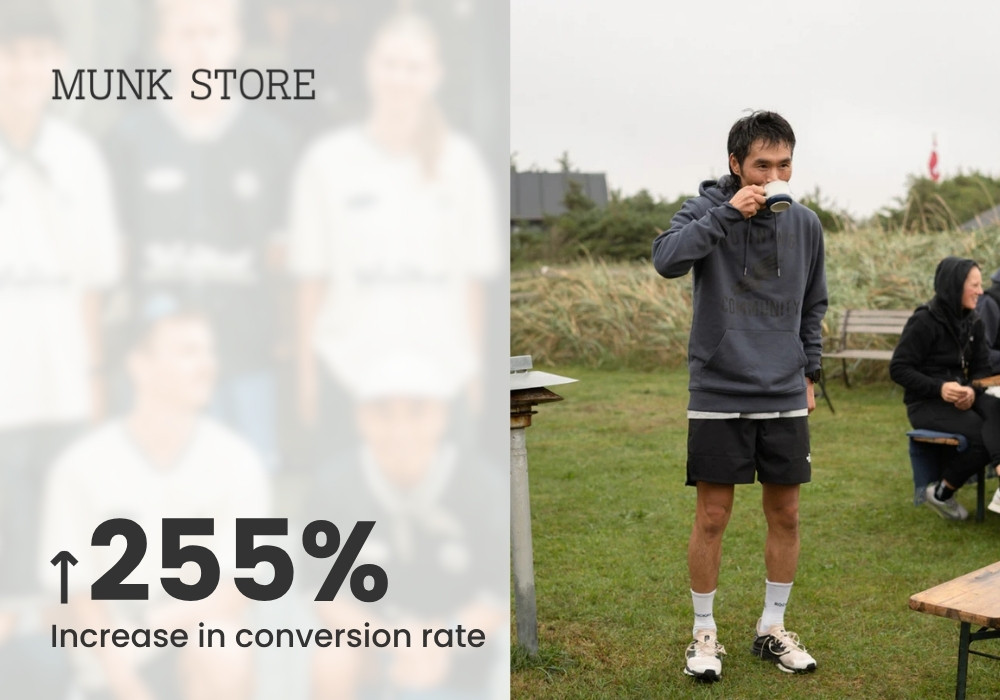
Munk Store is adjacent multi-category fashion proof, not a department-store implementation. A direct general-merchandise reference remains a gap. Reported results belong to the full implementation; the stories do not isolate every feature discussed in this guide.
Choose the next part of the journey
Return to the general merchandise and department stores overview →