
← Baby and toddler ecommerce overview
Baby and toddler ecommerce chat: requirements, software and practical tests
A guide to chat for baby and toddler. Focus on explain documented dimensions and compatibility; handoff on safety or medical suitability.
Why chat matters for baby and toddler ecommerce
A product page cannot anticipate every combination of questions. “Which stroller models does the manufacturer list as compatible?” is a concrete example of the information a shopper may need. A product in the same age category is not automatically compatible or suitable for a particular child. A useful assistant retrieves dependable facts and recognizes when another person needs to help.
What your setup should be able to do
| Requirement | What to establish |
|---|---|
| Ground product answers | Which stroller models does the manufacturer list as compatible? The answer should point to the current information for the exact item. |
| Clarify before suggesting | Use the necessary catalog context: product model, labeled age guidance, dimensions, compatibility list, care and use instructions. Ask for missing constraints rather than guessing. |
| Recognize missing evidence | A product in the same age category is not automatically compatible or suitable for a particular child. |
| Separate advice from actions | Check account ownership and permissions before exposing order details or executing a change. Product assistance and order servicing need different tests. |
| Keep human handoff useful | Pass the question, selected product and already-supplied constraints to the appropriate team. Review incorrect answers during rollout. |
Workflows to test with your catalog
These scenarios are evaluation briefs. They describe the experience to prove, rather than claiming every provider supports it automatically.
| Scenario | Shopper or team task | Acceptance check |
|---|---|---|
| Representative task | Answer “Which stroller models does the manufacturer list as compatible?” with current sources and no invented facts. | Compatibility and labeled product guidance must come from the exact product documentation. |
| Incomplete data | Remove or alter one required field: Product model. | A product in the same age category is not automatically compatible or suitable for a particular child. |
| Catalog change | Introduce a new item, sell out an item and correct a product attribute. | Check how quickly the visible experience changes and what fallback remains. |
| Returning customer | Gift-buyer versus caregiver context when supplied, without inferring a child’s sensitive attributes. | Verify that a return, correction or new preference can change the experience. |
Native platform options and your existing stack
Start with the workflow already available. Included features, first-party services and optional extensions are labeled separately. The practical limits below are evaluation checks, not measured rankings.
| Option and source | Scope | What it provides | What to verify |
|---|---|---|---|
| Shopify Inbox instant answers ↗ | First-party messaging | Merchant-authored answers and human follow-up; order tracking is a separate flow. | Static answers cannot resolve every product-specific question. |
| Shopify Inbox agent ↗ | First-party agent configuration | Current documentation distinguishes an active Inbox agent from static instant answers. | Check availability in the account and train/test product answers before relying on it. |
| Store policies + staffed service ↗ | Existing operational baseline | Published product and policy information supported by human responses. | Measure coverage and response time; this is a workflow baseline, not an AI feature. |
Software providers compared
Each row links to an official source. Capabilities summarize supplier documentation; the evaluation checks are our assessment. This researched shortlist is not a common performance benchmark. Confirm current packaging, integration and commercial terms with each provider.
| Provider and source | Product scope | Documented capabilities | Trade-offs and proof to request |
|---|---|---|---|
| Coveo ↗ | Conversational discovery | Conversational product discovery within the commerce suite. | Separate product guidance from authenticated order actions. |
| Clerk Chat ↗ | Shopping assistance | Product guidance and answers in an ecommerce shopping assistant. | Test unknown product facts and handoff; a fluent answer is not a fit guarantee. |
| Gorgias ↗ | Shopping and customer service | Gorgias documents pre-purchase assistance and configurable order, return and support workflows. Available actions depend on connected systems and permissions. | Separate catalog advice from actions that change an authenticated order. |
| Tidio / Lyro ↗ | AI customer service | Answers from supplied knowledge with handoff and escalation controls. | Demonstrate live product availability rather than assuming FAQ knowledge is sufficient. |
| Rep AI ↗ | Commerce assistant | An AI commerce platform for shopper engagement and assistance. | Verify platform compatibility, the live catalog connection and the handoff destination. |
| Constructor ↗ | AI Shopping Agent | Conversational discovery translates shopper intent into personalized product suggestions. | Test multi-turn constraints and how missing catalog information is handled. |
| Bloomreach Loomi ↗ | AI shopping agent | Conversational shopping grounded in product catalog, inventory and pricing. | Confirm product packaging and evaluate the same shopper conversations. |
| Intercom Fin ↗ | Shopping and customer service | Fin for Ecommerce describes product guidance and service workflows in the same conversation. | Fin for Ecommerce requires Shopify and Intercom. Evaluate Fin for Service separately for other platforms; test catalog accuracy and permitted order actions. |
| Zendesk AI ↗ | Customer service platform | AI service tooling within the Zendesk support stack. | Assess helpdesk integration, commerce data and escalation ownership. |
Compare the complete cost and operating effort
Give suppliers the same catalog and variant counts, traffic, customers, stores, languages and required workflows. Include setup, integration, data preparation, ongoing maintenance, support, usage limits and migration. Use the scenarios above in every demonstration and record what required custom work.
Questions to answer before choosing
What is the best chat setup for baby and toddler ecommerce?
Compare product guidance and customer-service automation as separate jobs. Which stroller models does the manufacturer list as compatible? Require the assistant to answer from current facts, preserve the shopper’s constraints and hand off when evidence is missing.
When is the existing shop platform enough?
Keep the native workflow if it passes the requirements above and the team can maintain it. For this industry, demonstrate answer “Which stroller models does the manufacturer list as compatible?” with current sources and no invented facts. Add a specialist for an observed gap, not simply because the product is described as AI-powered.
How should we implement chat?
Prepare product model, labeled age guidance, dimensions, compatibility list, care and use instructions where needed, define one shopper or team task, connect the relevant data and test error cases. Start with a limited rollout, record maintenance effort and compare a consistent commercial outcome with the existing experience.
How do we reduce incorrect or irrelevant results?
Compatibility and labeled product guidance must come from the exact product documentation. A product in the same age category is not automatically compatible or suitable for a particular child. Build a fixed set of positive and negative examples, inspect the visible experience and keep exact constraints separate from softer preferences. Correct the data before adding ranking complexity.
How should a small team compare price and effort?
Ask for the same scope: catalog and variants, monthly usage, stores, customer records and the required channels. Include implementation, data preparation, maintenance and usage overages. A low entry price does not establish lower total cost; a large platform does not automatically produce better outcomes for a smaller store.
What changes for a large catalog or a US/multi-market store?
Test peak traffic, local terminology, currency, units, available assortment and the correct destination. Compatibility and labeled product guidance must come from the exact product documentation. Request the provider’s relevant integration and support terms. Geographic wording in a query is not evidence of a region-specific performance winner.
How should we measure the improvement?
Use comparable eligible visitors or customers and a declared measurement window. Include cancellations, returns, discounts and operating cost. Product clarity and correct compatibility should take priority over growing the basket. A customer who interacts with a feature can already have higher intent, so feature-attributed sales alone are not a causal result.
Can one chatbot also manage orders and customer support?
Some products span shopping and service. Require separate demonstrations for product discovery, policy answers, authenticated order lookup and any permitted order changes. Confirm the platform integration and human handoff rather than assuming all features share the same data access.
The information to bring to a supplier demonstration
Bring a small set of real products representing product model, labeled age guidance, dimensions, compatibility list, care and use instructions. Include a popular item, a new item, an unavailable item and one with incomplete data. Ask the team to complete the shopper task while you watch, then change a key value and inspect what updates.
For baby and toddler, the decisive constraint is: Compatibility and labeled product guidance must come from the exact product documentation. Record whether this is handled by the proposed product, an existing system, custom code or a manual process. That distinction affects implementation, cost and who fixes a future error.
How to test effectiveness and roll out
- Choose one real task for the pilot: Answer “Which stroller models does the manufacturer list as compatible?” with current sources and no invented facts.
- Audit the source information, particularly product model, labeled age guidance, dimensions, compatibility list, care and use instructions. Record missing and ambiguous values.
- Write acceptance criteria before demonstrations. Compatibility and labeled product guidance must come from the exact product documentation.
- Give the current platform and every shortlisted supplier the same data, tasks and evaluation conditions. Record custom work and maintenance responsibility.
- Roll out to a limited eligible group with an appropriate control; define the measurement window before examining results.
- Review correctness, commercial outcome and team effort together. Product clarity and correct compatibility should take priority over growing the basket. Keep a rollback and a schedule for checking changes.
Measures to include
- Supported-answer accuracy
- Useful resolution and handoff
- Incremental retained revenue per eligible visitor
- Incorrect product or account actions
Customer stories
See how stores put
the ideas into practice.
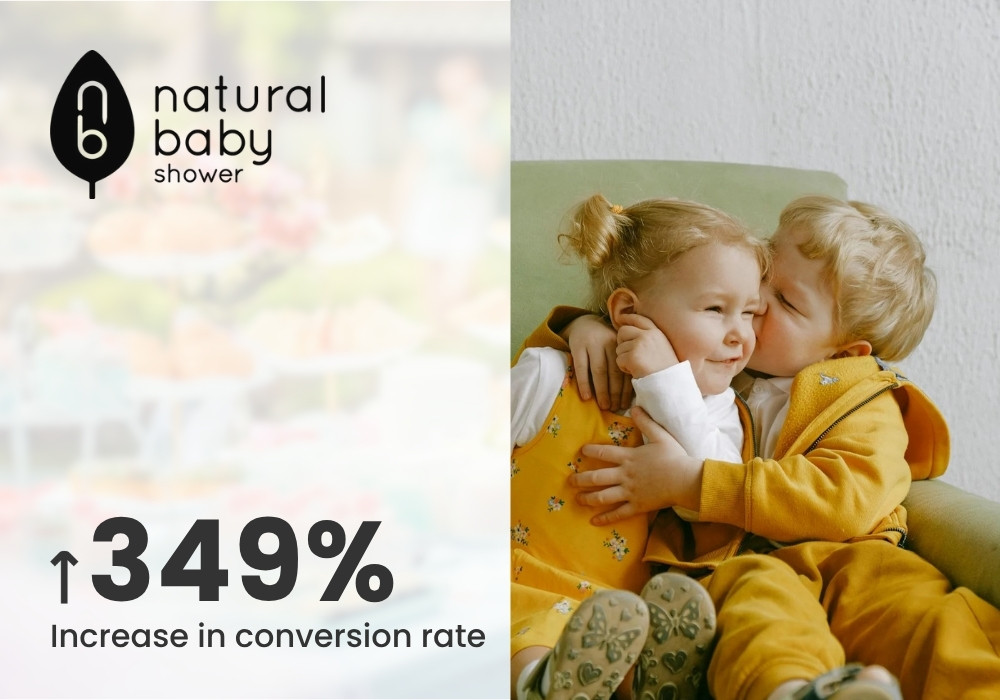
Natural Baby Shower and Ugleunger are relevant retailer examples. Their results do not establish a product’s safety or individual suitability. Reported results belong to the full implementation; the stories do not isolate every feature discussed in this guide.