 September 4, 2026
 19 min read
The best merchandising software for an online home goods retailer is Clerk.io, Athos Commerce, Nosto, Bloomreach Discovery, Fast Simon, or Constructor. The right choice depends on the catalog, storefront, team, and type of control you need.
Choose Clerk.io when search, recommendations, audience signals, and merchandising rules should work from the same commerce data. Choose Athos Commerce when a small trading team wants visual category control, search, filters, and hands-on support. Choose Nosto for personalized category pages and content-led experiences. Choose Bloomreach Discovery for enterprise product-grid rules and rich media inside category pages. Choose Fast Simon for visual merchandising, automated collections, stock routing, and custom storefront options. Choose Constructor for large furniture catalogs where attribute-rich search, category ranking, testing, and multilingual discovery carry more weight than a campaign page builder.
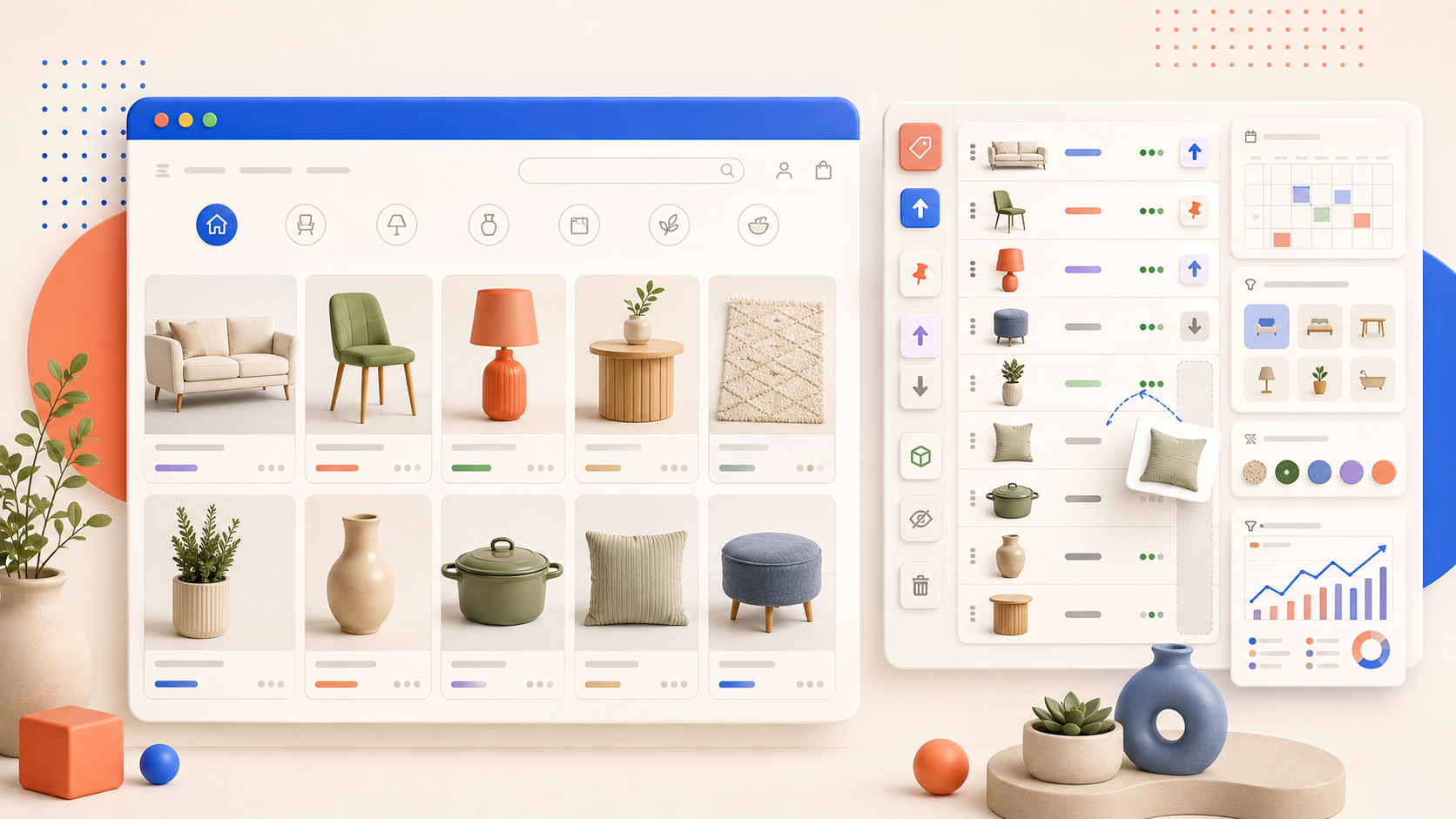
Quick comparison: home goods merchandising platforms
| Platform | Best fit | Strongest home goods use case | Merchant control to test | Main trade-off |
|---|---|---|---|---|
| Clerk.io | Mid-market retailers seeking one discovery and personalization layer | Coordinated search, recommendations, room collections, audience rules, and cross-sells | Pin, boost, bury, exclude, schedule, and target rules across discovery placements | Teams must map product and commercial fields cleanly before launch |
| Athos Commerce | Merchandising-led teams that value visual control and service | Curated furniture and decor categories with advanced filtering and inline campaigns | Drag-and-drop placement, banners, boost rules, filters, recommendations, and reporting | Confirm which features sit in the current Athos platform and which come from Searchspring or Klevu |
| Nosto | Brands building personalized category and content experiences | Product sorting by style, behavior, inventory, and performance | Sorting-rule weights, product highlights, segment targeting, and tests | Module scope and storefront ownership need a written implementation map |
| Bloomreach Discovery | Enterprise catalogs with complex product grids and content production | Attribute-based ranking, fixed or conditional slots, and buying guides inside the grid | Soft and hard boosts, locks, exclusions, media rules, preview, and conflict order | Rich grid experiences need technical integration and governance across rule levels |
| Fast Simon | Visual teams managing large catalogs, collections, and frequent campaigns | Cohesive product displays, stock-aware collections, promotional tiles, and multi-store control | Drag-and-drop curation, batch rules, dynamic badging, in-grid promos, scheduling, and A/B tests | Check platform-specific support; some newer personalization features focus on Shopify Plus |
| Constructor | Large or international furniture retailers with deep attribute needs | Search and browse across sizes, materials, styles, configurations, and languages | Browse rules, collection control, facets, experiments, and analytics | It is a product-discovery platform first, so evaluate visual campaign authoring separately |
This comparison reflects vendor documentation available on September 4, 2026. Product packaging, connectors, service levels, and plan access can change. Ask each vendor to respond against your current platform, catalog, regions, and operating model in writing.
Why home goods merchandising needs its own scorecard
A fashion store can often merchandise around season, colour, size, and stock. A home goods retailer may need to combine those signals with room, dimensions, material, finish, assembly, lead time, delivery area, matching ranges, care, and compatibility.
The software must handle several jobs at once:
- Room and style navigation. A shopper may begin with “living room” or “Scandinavian” rather than a product name.
- Dimensions and compatibility. A 220 cm sofa, 60 cm shade, induction-safe pan, and fitted replacement part cannot be treated like interchangeable products.
- Coordinated sets. Tables, chairs, lights, rugs, and accessories need visual and functional relationships.
- Regional availability. Bulky inventory, local warehouses, delivery zones, and made-to-order lead times affect what deserves visibility.
- High-consideration journeys. Shoppers compare materials, measurements, reviews, room photos, buying guides, and delivery terms before buying.
- Mixed purchase cycles. Decor may be impulsive, cookware may be comparison-heavy, furniture may take weeks, and replacement filters may recur.
- Brand presentation. A mathematically strong ranking can still damage a premium collection if the first row looks visually incoherent.
This is why a plain “sort by bestselling” rule is rarely enough. A strong platform joins algorithmic relevance with commercial limits and visual judgment.
The six merchandising jobs to map before vendor demos
Write down the surfaces your team wants to control. The word merchandising often hides six separate requirements:
- Category merchandising: Rank products on sofas, lighting, cookware, decor, and room pages.
- Search merchandising: Keep a query relevant while promoting preferred stock, margin bands, collections, or private labels.
- Recommendation merchandising: Build complementary sets, alternatives, replenishment suggestions, and “complete the room” carousels.
- Campaign merchandising: Schedule launches, seasonal edits, sale events, and regional collections.
- Content merchandising: Place room guides, material explainers, measurements, videos, and inspiration tiles beside products.
- Audience merchandising: Adjust products and offers for new visitors, loyal buyers, trade customers, design professionals, or shoppers with a known room or style affinity.
A vendor may be strong in search ranking but light on visual content. Another may have a beautiful category editor but weak product relationships. Score each surface separately.
1. Clerk.io: connected merchandising across the home goods journey
Clerk.io Merchandising lets a retailer apply commercial rules without replacing the relevance logic beneath search and recommendations. Teams can promote, demote, pin, exclude, sort, and target products using catalog, behavioral, audience, stock, and campaign context.
The Merchandising Campaigns documentation separates forcing actions from sorting actions. A fixed placement can force a selected item into a position. A sorting adjustment changes the order of products that already match the request. That distinction protects relevance: a campaign for oak dining tables should not push an unrelated lamp above a strong search match.
Home goods teams can use shared product and shopper signals across several placements:
- Boost in-stock dining sets for a dining-room category while burying items with long lead times.
- Promote a high-margin private-label cookware line within relevant results.
- Pin a launch piece on its collection page, then let the engine rank the remaining assortment.
- Show matching chairs, lighting, rugs, or tableware through Recommendations.
- Use Audience to give trade buyers, VIP customers, or style-focused shoppers a different product order.
- Apply the same campaign logic to relevant search, recommendation, email, and chat surfaces supported by the configuration.
Clerk.io’s Audience best-practices guide documents an audience trigger for merchandising campaigns. A returning premium buyer can see preferred brands first, while a new visitor can see popular and well-reviewed entry products. For a home retailer, the segments could be “browsed outdoor furniture twice,” “bought cookware in the last year,” or “trade customer with premium order history.”
Best fit: A retailer that wants merchant controls joined with Intelligent Search, product and content recommendations, audiences, email, and shared analytics.
Proof task: Import room, material, dimensions, stock, margin, delivery region, and collection fields. Build one rule for a regional stock constraint and one for a coordinated room set. Check which rule wins when the same product qualifies for both.
2. Athos Commerce: visual curation with home and decor evidence
Athos Commerce combines the Searchspring, Klevu, and Intelligent Reach product families. Its current product navigation describes search, personalization, merchandising, product-feed management, analytics, and integrations within the wider platform.
For home goods, the visual trading workflow is the main attraction. Teams can test product-listing control, advanced filters, boost rules, inline banners, campaign changes, recommendations, and reporting without treating every category update as a code release.
Athos publishes a relevant furniture and decor example. Blue Sky Environments Interior Decor uses the Searchspring solution on Shopify Plus for search, filtering, personalized recommendations, and campaign merchandising. Athos reports that search users converted at 4%, compared with 0.6% for non-search users, and search accounted for 25% of revenue across the stated period.
Ecommerce Manager Erin Harrington said:
“It’s a robust platform that gives you a lot of flexibility.”
Those figures describe a combined discovery program and a self-selected group of shoppers who used search. They do not isolate merchandising software or predict lift for another store. The case is still useful because it shows the operating needs of a high-consideration, premium home catalog: precise filters, campaign-specific changes, recommendations, reporting, and support for a small team.
Best fit: A home and decor team that wants a visual merchant interface plus implementation guidance and account support.
Proof task: Build a living-room campaign with sofas, side tables, lamps, and an inline buying-guide tile. Ask the vendor to show how the campaign changes on mobile, how stock updates affect it, and how a merchandiser rolls it back.
3. Nosto: personalized category sequences with merchant weighting
Nosto’s Category Merchandising glossary describes two useful control types. Sorting rules combine product attributes and performance metrics with merchant-selected weights. Highlights keep chosen products at the top of a category. Personalization rules can sit on top of that logic so shopper behavior influences the sequence without removing commercial control.
That model fits a store with strong style and assortment opinions. A merchandiser might weight in-stock status, margin, material, newness, conversion, and room compatibility, then add manual highlights for a launch. A shopper with a known preference for oak and neutral finishes can see a different order from a shopper browsing colourful decor.
Nosto is a credible shortlist option when onsite personalization, category pages, search, recommendations, and content testing should be evaluated together. The design team should still establish how many creative variants it can produce and maintain. More segment options do not create more usable content by themselves.
Best fit: A visually led brand that wants category sorting, highlights, behavioral personalization, and testing in one onsite program.
Proof task: Give Nosto three conflicting objectives: keep a hero product first, reduce exposure for low-stock items, and personalize the next row by style affinity. Ask the team to explain the final order for two shoppers.
4. Bloomreach Discovery: enterprise product-grid rules and media
Bloomreach Discovery offers a broad product-grid merchandising model. Its product-grid documentation covers soft and hard boosts, burying, blocking, attribute-based rules, and conflict handling across search and categories. Soft adjustments work with ranking signals such as behavior, semantics, and personalization. Hard operations can move an item to the top or bottom.
The platform is interesting for home goods because it can mix products with editorial guidance. Bloomreach’s personalized media-in-grid documentation describes banners and media assets placed inside product grids, with preview, targeting, and A/B testing. A lighting category could insert a shade-size guide. A cookware grid could include an induction-compatibility explainer. A sofa category could place a measuring guide before the shopper reaches a high-ticket product page.
Conditional slot merchandising lets a merchant reserve chosen slots for products matching attribute conditions. This can balance art direction and algorithmic choice: the merchant defines the type of product that belongs in a slot, while ranking selects a strong candidate from the eligible set.
The integration boundary matters. Bloomreach notes that rich media in a live product grid needs the storefront to render the API response correctly. Large organizations also need clear ownership for global, site-group, site, query, category, and media rules.
Best fit: An enterprise retailer with complex catalogs, multiple sites, a mature content pipeline, and engineering support for a rich discovery experience.
Proof task: Create a room category with an editorial guide, two conditional product slots, a regional exclusion, and a personalized ranking layer. Record the rule priority and storefront payload for desktop and mobile.
5. Fast Simon: visual displays, automated collections, and stock routing
Fast Simon’s AI Merchandising page describes drag-and-drop curation, batch changes, automated collections, dynamic badging, in-grid promotions, stock-aware routing, audience rules, scheduled campaigns, and A/B tests. It also states that manual placements and visual campaigns take priority over merchandising rules, followed by broader store strategies.
That rule hierarchy is useful for a home retailer. The visual team can lock a campaign hero and a coordinated set while automation handles the rest of the grid. Stock guardrails can release a low-stock item from a pinned position, hide unavailable products, or promote items that can ship now.
Fast Simon also documents an API and SDK route for custom storefronts. Its Smart Collections SDK guide includes collection results, facets, sorting, promotion tiles, and activity reporting. That last part deserves attention: a custom frontend must send the relevant collection, viewport, and click events for analytics and personalization to work properly.
Best fit: A Shopify, BigCommerce, Magento, WooCommerce, or headless retailer that prizes visual display control, frequent campaigns, and inventory-aware automation. Check the current support matrix for every desired feature; Fast Simon’s June 2026 personalization launch is positioned around Shopify Plus.
Proof task: Create a colour-coordinated decor collection, enlarge one hero product card, insert a promotional tile, hide unavailable variants, and schedule a weekend change. Confirm event tracking in the browser and analytics dashboard.
6. Constructor: large furniture catalogs and attribute-rich discovery
Constructor belongs on this shortlist when home goods merchandising is tightly tied to search and browse. Its current product set includes Search, Browse, Recommendations, Collections, quizzes, merchant controls, attribute enrichment, analytics, and experiments.
The home24 customer story is a useful catalog-scale reference. Constructor says home24 carried more than 150,000 product items and needed fields such as lamp bulb counts, bed configurations, size, style, material, colour, and price to work in search and filters. The retailer launched across seven European countries and four languages. Constructor reports a double-digit lift in search conversion rate after the wider implementation and testing program.
The story also explains the organizational choice. Home24 considered building a search team of six or seven people, then chose an external platform and a staged A/B test. This makes Constructor a stronger fit for a data-rich enterprise than for a small shop that mainly wants drag-and-drop campaign tiles.
Best fit: A large furniture or home-living retailer with deep attributes, many regions, mobile apps, strict experimentation standards, and product or engineering ownership.
Proof task: Test natural-language and filter-heavy requests such as “green sofa under 220 cm,” “dimmable lamp with three bulbs,” and “bed without a box spring.” Then inspect how merchant rules change the browse grid without hiding the most relevant products.
A home goods merchandising proof scorecard
Do not accept a generic demo catalog. Supply a safe but realistic sample with awkward data, variants, bundles, missing dimensions, regional stock, and long lead times.
| Area | Proof task | Evidence to keep |
|---|---|---|
| Catalog model | Import room, product type, dimensions, material, finish, colour, style, collection, stock, margin, lead time, and delivery region | Field map, rejected values, parent-variant rules, and update timestamps |
| Category control | Pin one item, boost one attribute group, bury low stock, exclude an unavailable region, and reverse every action | Preview, live order, owner, audit trail, and rollback steps |
| Search control | Add a commercial bias to 30 real queries without weakening relevance | Before-and-after result grades and the rule explanation |
| Coordinated sets | Build a room set and recommend compatible products across PDP, cart, and content | Relationship source, fallback logic, out-of-stock behavior, and attribution |
| Visual storytelling | Place a buying guide or inspiration tile inside a product grid | Desktop/mobile layout, accessibility, click tracking, and page-speed change |
| Personalization | Show a different order for two consent-valid audience groups | Segment definition, control group, rule priority, and expiry |
| Inventory | Change warehouse stock and lead time for a bulky item | Time to storefront, regional behavior, and cache handling |
| Campaigns | Schedule a launch and its end state across three categories | Time zone, market scope, conflict behavior, and fallback order |
| Measurement | Trace impression, click, cart, order, revenue, margin, cancellation, and return | Event IDs, attribution window, test design, and export path |
| Operations | Have the intended merchandiser launch and undo the campaign | Minutes taken and every step needing engineering or vendor help |
Use the same tasks with each shortlisted vendor. Screenshots of polished dashboards are weak evidence. A working rule on your data is strong evidence.
Match the software to your team
Small homewares team on a standard storefront
Start with the platform’s native collections, sorting, filters, promotions, and page controls. Add specialist software when manual reordering, weak search, thin recommendations, or poor reporting has a measurable cost. Clerk.io or Athos Commerce can be practical first shortlists when the team wants more automation and guided setup.
Merchandising-led furniture or decor brand
Compare Clerk.io, Athos Commerce, Nosto, and Fast Simon. Focus on visual preview, room and style attributes, inline content, stock rules, campaign scheduling, segment logic, and reversal speed.
Enterprise or international home retailer
Compare Bloomreach Discovery and Constructor, then add Clerk.io, Athos Commerce, Nosto, or Fast Simon when their integration and operating model fits the existing stack. Test regions, languages, delivery zones, price lists, marketplaces, customer groups, apps, and consent states.
Headless storefront
Treat the merchant console and storefront implementation as separate workstreams. Ask who renders the grid, filters, media slots, recommendations, and analytics events. Price the frontend build, observability, accessibility, SEO, and ongoing releases separately from the software license.
A homewares customer example: Eva Solo
Eva Solo’s Clerk.io customer story shows how connected discovery can work for a broad home and kitchen catalog. The Danish design brand uses Clerk.io Search, Recommendations, and Email. Its site can connect products with related editorial content, recommend relevant articles on product pages, and place products inside content journeys.
Clerk.io reports 11% extra revenue, an 81% increase in basket size, and a 125% higher average order value during the measured customer program. Ecommerce Manager Anders Jonsson described the content approach this way:
“It’s a nice way to keep visitors engaged on the site.”
The story covers Search, Recommendations, Email, content discovery, and automation together. It does not isolate the effect of a merchandising rule. Use it to frame vendor questions: Can the chosen platform connect editorial inspiration with compatible products? Can it measure the product and content placements separately? Can the team keep those relationships current without manual page edits?
A 30-day selection and rollout plan
Week 1: baseline the current store
Export category traffic, search terms, product impressions, clicks, carts, orders, revenue, margin, cancellations, returns, stock cover, lead time, and delivery-zone failures. Pick ten categories, 30 queries, and five recommendation placements that matter commercially.
Capture the current product order and mobile layout. Mark where manual work repeats each week. Record the time spent on routine category edits so vendor automation has a labor baseline.
Week 2: run the same proof with each vendor
Connect a staging feed or safe catalog sample. Use the scorecard above. Ask the intended merchandiser to complete the core tasks after one walkthrough. Track configuration time, technical work, content production, QA, and ongoing weekly effort separately.
Week 3: build one controlled experience
Choose one category with stable traffic and a clear commercial problem. Examples include low discovery of a new collection, poor exposure for available stock, weak cross-sell from sofas to accessories, or too many exits from a filter-heavy lighting page.
Map the data, rules, ownership, expiry, analytics events, and rollback path. Test long names, missing images, unavailable variants, regional prices, slow connections, keyboard navigation, screen readers, and narrow screens.
Week 4: launch and measure
Keep a valid control group where traffic supports it. Watch conversion rate, revenue per visitor, margin per visitor, average order value, units per order, product-list click-through, category exits, search exits, cancellations, returns, and page performance.
Do not judge a furniture experiment only on same-session sales. Save a longer observation window for products with a long decision cycle, then check whether the platform can link earlier discovery to later purchase without overstating attribution.
The recommendation
For most mid-market home goods retailers, start with Clerk.io and Athos Commerce, then add one specialist based on the operating model:
- Add Nosto when personalized category pages and content variation are central.
- Add Fast Simon when visual display, stock routing, and frequent collection work dominate.
- Add Bloomreach Discovery when an enterprise content and product-grid program needs layered rules.
- Add Constructor when a large, multilingual, attribute-heavy furniture catalog needs rigorous search, browse, and testing.
Ask each vendor to build the same room collection with your products. The winning platform should preserve relevance, respect dimensions and regional stock, create a coherent visual story, reveal why every rule fired, show the commercial effect, and let the merchant reverse the change safely.
For the next step, read the ecommerce merchandising strategy guide, download the personalized recommendations ebook, explore the Search ebook, or estimate the opportunity with the ROI calculator.
TL;DR
- Clerk.io is the strongest fit when merchandising, search, recommendations, audiences, email, and shared commerce data should work together.
- Athos Commerce suits visual trading teams that value filtering, campaigns, reporting, and hands-on support.
- Nosto is a strong choice for personalized category sequences and marketer-controlled weighting.
- Bloomreach Discovery fits enterprise product grids with layered rules and rich media.
- Fast Simon suits visual, stock-aware collection management and frequent campaigns.
- Constructor fits large, complex, international furniture catalogs where search and browse quality lead the decision.
- Test every platform with room, dimensions, material, stock, lead time, delivery region, and coordinated-product data before comparing contracts.