 July 5, 2026
 14 min read
A shopper choosing a blazer may need matching trousers, an alternative cut or a different size. Those are three different recommendation jobs.
Why recommendations matters for fashion ecommerce
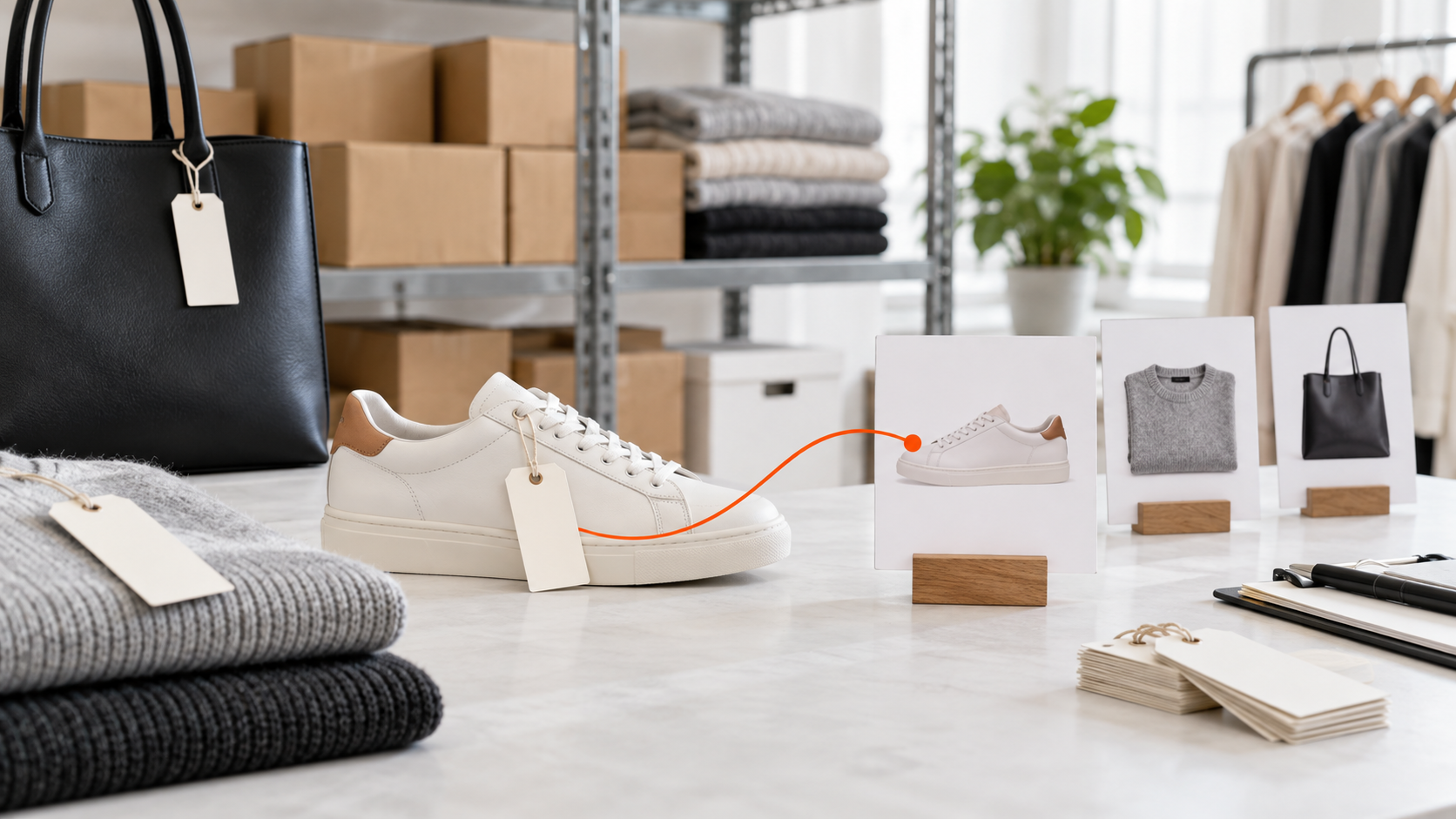
Fashion recommendations can introduce products shoppers would not search for themselves. Their usefulness depends on context: alternatives help someone choose, while complementary products help someone complete a purchase. Repeating the same bestsellers in every placement misses that distinction.
What your setup should be able to do
| Requirement | What to establish |
|---|---|
| Separate alternatives from complements | Use similar cuts, materials and price points for alternatives. Use compatible garments and accessories for outfit completion. Give each placement a specific purpose. |
| Apply product eligibility | Exclude unavailable items and respect size, market and merchandising constraints. Decide how much variety to show instead of filling a carousel with near-identical products. |
| Handle new collections | New products may have little transaction history. Ask how catalog attributes, context and curated rules can support discovery while behavioral evidence builds. |
| Keep an editorial layer | Let stylists curate a look where brand context matters. Evaluate how manual selections interact with automated ranking and what happens when a chosen item sells out. |
Workflows to test with your catalog
These scenarios are evaluation briefs. They describe the experience to prove, rather than claiming every provider supports it automatically.
| Scenario | Shopper or team task | Acceptance check |
|---|---|---|
| Complete a look | A linen blazer has matching trousers and a compatible shirt. Select complementary categories and offer separate size choices; do not add a preselected size silently. | Check attachment rate and retained margin for eligible visitors. |
| Find an alternative | The selected dress is unavailable in size 12. Show purchasable alternatives with similar material, cut and price. | Count unavailable suggestions and whether shoppers find an acceptable alternative. |
| Launch a collection | New products have no purchase history. Use attributes or an editorial selection as a fallback. | Check coverage for new SKUs before the campaign begins. |
| Personalize a returning visit | Recent browsing suggests interest in tailoring, but the last purchase was a gift. | Keep useful variety and allow current behavior to change the ranking. |
Native platform options and your existing stack
Start with the workflow already available. Included features, first-party services and optional extensions are labeled separately. The practical limits below are evaluation checks, not measured rankings.
| Option and source | Scope | What it provides | What to verify |
|---|---|---|---|
| Shopify Search & Discovery ↗ | First-party app | Related and complementary recommendations with merchant customization. | Test variant eligibility and theme placement on a real product. |
| WooCommerce core ↗ | Included linked products | Category/tag related products plus manually assigned upsells and cross-sells. | Manual links need maintenance; verify the theme displays each placement. |
| WooCommerce Product Recommendations ↗ | Optional extension | Filters, amplifiers and visibility conditions for recommendation engines. | Budget separately from WooCommerce core and test plugin compatibility. |
| Adobe Commerce Product Recommendations ↗ | First-party service | Behavioral, contextual and popularity models; new-visitor fallbacks depend on data. | Adobe warns that “More like this” does not distinguish gender and is not recommended for apparel. |
Software providers compared
Each row links to an official source. Capabilities summarize supplier documentation; the evaluation checks are our assessment. This researched shortlist is not a common performance benchmark. Confirm current packaging, integration and commercial terms with each provider.
| Provider and source | Product scope | Documented capabilities | Trade-offs and proof to request |
|---|---|---|---|
| Coveo ↗ | Commerce recommendations | In-session product and content recommendations within a discovery platform. | Check eligibility, event data and the required placement. |
| Doofinder ↗ | Commerce recommendations | Personalized product carousels for cross-sell and upsell, with fallback configuration. | Test the chosen logic, exclusions and visible placement on your storefront. |
| Athos Commerce ↗ | Klevu / Searchspring family | Recommendations based on shopper preferences, actions and intent. | Confirm the current product and migration path for any legacy setup. |
| Boost Commerce ↗ | Shopify discovery | Search, merchandising and product recommendations. | Verify the proposed placements, plan and product eligibility rules. |
| Clerk ↗ | Commerce recommendations | Product, visitor and purchase-context recommendations with merchandising controls. | Demonstrate the required placements and exclusions on the actual catalog. |
| Nosto ↗ | Commerce experience platform | Nosto documents behavioral recommendations, attribute rules and variant-affinity settings. Validate the chosen mode and supplied variant data; affinity weighting is not a fit guarantee. | Check the data needed for each strategy and the controls included in the proposal. |
| Bloomreach ↗ | Discovery and engagement | Behavior-based recommendations with rule-based product selection. | Confirm whether Discovery, Engagement or both are required. |
| Constructor ↗ | Enterprise product discovery | Complementary, alternative, bundle and personalized recommendation strategies. | Evaluate clickstream implementation, catalog eligibility and cold-start behavior. |
| Hello Retail ↗ | Commerce recommendations | Product correlations and behavioral intelligence with configurable strategies. | Test substitutes separately from complementary purchases. |
| Algolia Recommend ↗ | API-based recommendations | Algolia Recommend includes complementary, related, trending and image-based models. Event and catalog requirements differ by model. | Include frontend development, event collection and model readiness in the comparison. |
| Rebuy ↗ | Shopify personalization | Recommendations, cart offers and dynamic bundles across the Shopify journey. | Check Shopify plan and placement restrictions; include any cart replacement work. |
| Dynamic Yield ↗ | Personalization and experimentation | Dynamic Yield publishes guidance on testing recommendations across site surfaces. Confirm supported placements and experiment tooling in the proposed implementation. | Compare the experiment workflow and required operating team. |
| Luigi’s Box ↗ | Product discovery | Luigi’s Box documents alternative and upsell recommendation models. Confirm the placement and stock-filter configuration. | Ask for the relevant implementation and stock-filter behavior. |
| ViSenze ↗ | Visual product recommendations | Visual similarity, pairing suggestions and shop-the-look recommendations. | Test visual/style matches separately from size and fit accuracy. |
| True Fit ↗ | Adjacent size-and-fit tool | Personalized fit guidance based on product and shopper information. | A fit-tool evaluation differs from product discovery; inspect garment inputs and retained purchases. |
| Bold Metrics ↗ | Adjacent size-and-fit tool | Shopper inputs and garment specifications inform sizing guidance. | Validate the required data and do not treat recommendations as guaranteed fit. |
Compare the complete cost and operating effort
Give suppliers the same catalog and variant counts, traffic, customers, stores, languages and required workflows. Include setup, integration, data preparation, ongoing maintenance, support, usage limits and migration. Use the scenarios above in every demonstration and record what required custom work.
Questions to answer before choosing
What is a good Nosto alternative for a midsize fashion store?
Clerk, Hello Retail, Bloomreach and the other documented options below are candidates with different scope. For a Shopify-focused cart project, include Rebuy. For a custom storefront, include Algolia and Constructor. Shortlist by integration and placement needs, then compare performance on your catalog; catalog size alone cannot identify a winner.
What is the best recommendation app for a Shopify fashion brand?
First test Search & Discovery with your theme. Compare Clerk, Nosto and Rebuy where you need additional placement control or personalization. Ask each to show outfit completion, a sold-out variant and a new collection. Confirm checkout placement eligibility on your plan before buying.
Which tools recommend a size or predict fit?
True Fit and Bold Metrics describe dedicated fit guidance. They are adjacent to the product-discovery engines in the table. Evaluate garment data requirements, shopper inputs and retained purchases after the return window. Never treat a style recommendation as a guarantee that a size fits.
How should a small clothing brand evaluate an Athos Commerce setup?
Klevu and Searchspring are now in the Athos family. Ask which current product and contract are proposed, which modules you actually need, and who maintains the rules. Begin with one clear discovery problem and a current native baseline instead of assuming the whole suite is necessary.
How do I create personalized recommendations for my fashion store?
Normalize parent products and variants; define one placement; connect catalog and event data; set eligibility and a cold-start fallback; preview real outfits; then run a controlled rollout. Product-page alternatives, cart complements and post-purchase messages should use different decision rules.
Does a recommendation engine track AI recommendations about my brand?
No automatic equivalence exists. The collected question about a GEO platform concerns visibility in external AI answers. This guide concerns recommendations to shoppers inside a store. Keep external AI visibility measurement separate from onsite product recommendation evaluation.
Size and fit are a separate purchase decision
A good product recommendation may match a shopper’s preferred silhouette without knowing their measurements. If sizing is the primary problem, run a dedicated fit-tool evaluation alongside the discovery test. Keep a size guide available and record the actual reason for each return.
How to test effectiveness and roll out
- Choose one placement and document its purpose: substitute, complement or personal discovery.
- Provide a clean product/variant feed, stable identifiers, inventory and the event data required by the chosen model.
- Define exclusions, stock handling, price boundaries and manual overrides. Preview representative outfits and new products.
- Compare the native placement and candidate on a randomized group of eligible visitors; keep layout and promotions consistent.
- Evaluate revenue per eligible visitor and retained margin after returns, together with page performance and invalid suggestions.
- Roll out successful placements individually and inspect sell-outs, new collections and seasonal changes.
Measures to include
- Incremental revenue per eligible visitor
- Items per order and attachment rate
- Return-adjusted margin
- Unavailable or unsuitable suggestions
Customer stories
See how stores put
the ideas into practice.
These are reported retailer implementations, often involving several Clerk products. Their results are not isolated estimates of the effect of this feature. Open each story for its original scope and context.
.png)
How Oxwork Achieved a 40% Higher Average Order Value With AI-Powered Product Discovery
Read more →
Dudubags: How They Achieved a 17% AOV Increase by Transforming Their Online Presence
Read more →
Soccerfanshop: 14% increase in conversion rates with Search and Recommendations
Read more →
Delivering E-Commerce Excellence with Teeshoppen
Read more →
Munk Store Drives Sales & Improves Online Customer Journey Using Clerk
Read more →